For some years now my ears have been pestered by hearing certain oft-repeated words and phrases in the media and also in the speech I hear in my community. Here I present some of these in alphabetical order, with the idea that sometimes we may want to change our speech to reflect our thoughts more truly. Of course all this is from my own biases and opinions. The author may add items from time to time.
Dedicated to the late great Molly Ivins, whose humor and writings were of invaluable aid to me in preserving some sanity through the late 1900’s.
addiction. At some point I learned that “addiction” means addiction to a substance; therefore if on is referring to a dependency on another habit having detrimental effects on one, it is not actually an addiction. So, we can call it co-dependency, habit, uncontrolled gambling, or hoarding, or over-eating, etc.
average (citizen, or Canadian), also “ordinary,” or “everyday” Canadian. We are often called “average Canadians” in the media, especially by those who want us to listen to their ideas and opinions. I experience a little cringe every time I hear this, or “ordinary” or “everyday Canadian.” Is not this an insult? Are not all citizens special, unique, outstanding in some ways? Why not just say “Canadians” “or citizens”? To my ears “average” etc. implies some notion of social or financial standing. It can imply that the one speaking is not average or ordinary: the listener is.
battle with cancer; lost their battle with cancer, etc. This one really gets me. Cancer doesn’t start wars, and isn’t a disease, but a condition. There are various causes that can produce the condition, some of them being human-induced toxins and poisons into our environment and food, medications and other things we consume or to which we become exposed. Some cancers are related to genetics. When things make us ill, get our system out of balance, it is a working with that situation that one does–in all its aspects. If one dies from cancer or from whatever, death is not a battle, but a part of this miracle of life/death–this blessed mystery of our experience. If we are ill and do everything we can to be healed from the illness, that is not necessarily a “battle.” especially if it brings us closer to that which we value and love.
capitalism. Sometimes capitalism appears to be linked with political systems such as democracy. What we have now in our world is mostly rampant capitalism, which cannot really exist with democracy, as it creates a growing divide between the rich and poor while at the same time bringing global power in many forms to corporations, and to richer countries. There is nothing in the US or the Canadian Constitution that mentions capitalism as a part of the organization of the state.
cave...cavemen (persons). If one used the word “caveman,” (people), what do they actually mean? I have the thought that they may mean some half-human who lived in some unidentified era in the past and didn’t know enough to scrap together a tent or whatever. There have been, I suggest, some occasions in the past when catastrophic flooding forced people and animals to higher ground and caves would have provided safety, hopefully. Before such cataclysms those people may well have lived in very well-planned cities or communities with very admirable sets of values and social systems. Indeed there are many evidences of very advanced ancient societies around the world which we cannot yet explain.
civilization. What are the implications of this word, and of the word “uncivilized”? My dictionary gives the first definition as “an advanced stage or system of social development.” It does not define “advanced” or “social development.” It seems we do not really have any idea what civilization means, and it could be that it has a mostly limiting function when used. It can be used to imply that one’s society is civilized as opposed to another which is not. If we do not know what the word means this can lead to a supposed superiority or advancement over others, often without having really known the other.
climate change. This term has been used for some years now even though it conveys what is but one result of human-caused drastic earth changes: plant and animal species extinction, pollution of land water, oceans, air and atmosphere; sickness, cancers, drought, famine, mass migrations producing millions of migrants and refugees. Is not use of the term “climate change” a denial of the enormity of what human design is undoing, and the crucial need to make enormous changes in policies, economies, in supporting each other and all life? The way to sustainability is complex and demands working together. There are other terms being used by some for this time of our Mother Earth in crisis due to forces resulting from some of humanity having lost a vibrant relationship to Her.
collateraldamage. Now isn’t this a polished version of violent death, state murder? And casualty, the same. Why do newscasters not tell the naked truth: this is gory murder, dead bodies, the blood and guts of violence and war, of genocide and coups. It is not some lifeless toy or briefcase left on the side of the road.
death. Use of this word often implies a great loss–loss of Life. Yet life includes death. The two are not opposites. Can we find a word that encompasses the great experience from in the womb through birth, the years that follow, and the journey to the last breath? We enter the womb and are born knowing not from whence we come. We live, and just like other living creatures, fungi, plants…part of living is that life ends so that other life can flourish. My preference would be to have a word that means “life/death,” with the idea that it is all a blessing and a natural process. And death does not mean the spirit we have brought to this life is suddenly gone. Our hearts and minds carry the spirit of many who have died to whom we are very grateful. Life/death is a sacred experience–all of it. We cannot die unless we have been born, and vice versa. So there is no death in and of itself, but life/death.
defense. So many times we hear the word “defense” defending a country’s military/industrial budget. So, how much of that budget goes to offensive purposes rather than “defensive?” And what percentage of the total national budget goes toward military and related enterprises? Does that country produce and stockpile nuclear and other cataclysmic type weapons? Nuclear weapons are now in the process of being made illegal according to the activation of the UN ban on them. Of course only the nations which have signed the ban are obligated to follow it–and guess which nations have not signed it!
democracy. What does this word imply in our times? In Canada many eligible voters do not vote, and many people find it too hard to be able to vote though they may wish to do so. There are so many different national constructs in countries that identify as democratic. What power do the people have, up against corporate or institutionalized “power”? I suspect that many citizens graduate from high school with little idea of the rights and responsibilities of participating in democracy. However, these rights and responsibilities must be understood and taken seriously for a democracy to endure.
emissions. When CO2 and methane and other toxic emissions are mentioned in the media my mind goes straight to oxygen. As Earthlings we know our more recent ancestors had a great deal more oxygen in the atmosphere than is available to us today, and we know that it has been mainly human endeavors that have produced this very dire situation. And it is humans who must remedy this if it can be remedied. From Peter Tatchell, in The Guardian, August 13th, 2008, “The oxygen crisis:”
In the view of Professor Ervin Laszlo, the drop in atmospheric oxygen has potentially serious consequences. A UN advisor who has been a professor of philosophy and systems sciences, Laszlo writes:
Evidence from prehistoric times indicates that the oxygen content of pristine nature was above the 21% of total volume that it is today. It has decreased in recent times due mainly to the burning of coal in the middle of the last century. Currently the oxygen content of the Earth’s atmosphere dips to 19% over impacted areas, and it is down to 12 to 17% over the major cities. At these levels it is difficult for people to get sufficient oxygen to maintain bodily health: it takes a proper intake of oxygen to keep body cells and organs, and the entire immune system, functioning at full efficiency. At the levels we have reached today cancers and other degenerative diseases are likely to develop. And at 6 to 7% life can no longer be sustained.
enemy. Often in the media I hear the word “enemy” used, usually referring to a nation said to be an enemy of another nation. I do not identify with the word “enemy” used this way. I have no enemies, nor do I see a nation as having enemies. Such an idea only furthers the tendency to think of the other as separate rather than someone, some nation to get to know, to understand by sharing peacefully–all thoughts of “enemy” put aside.
environmentalist. Grrrr. I long ago was tired of hearing people like me being called environmentalists. This word separates people from Nature, does it not? And do not we who are doing what we can to save some Life on this planet make no separation between ourselves and our ecological systems? We are Nature; our existence depends upon Nature, whose biggest threat is from human doings. Many human endeavors are trying to destroy Life, whether this is a conscious process or not. I aim to live as a devotee of Sacred Gaia.
fake news. OK; why do we allow this term to be used? Since when was NEWS fake? Sometimes a newscaster may have been given the story wrong, yet such things are then corrected in the media. There is such a thing as a lie, or a false claim. Calling something fake news seems to open a way for confusion. Of course I do not remember this term being used before a certain person occupied a certain office.
fossil fuels. Much of what is termed fossil fuel is actually made up of oil products deposited on Earth by comets or other passing bodies. As presented by Dr. Immanuel Velikovsky, the burning deposits flew down to the Earth causing such pollution and darkness that much of the life on our planet was wiped out. At the same time the comet approach caused volcanic fires and ash. Ironically, now 41 years after Velikovsky’s death we are struggling with the consequences of our unconscious repetition of killing life on Earth from centuries of more and more burning of these fuels.
free trade. Free trade among nations is trade that does not restrict imports or exports. It is the free market idea applied to international trade. However, many countries using free trade impose tariffs to imports and subsidies to exports. Free trade is mostly separate from the practices of fair trade, which emphasize fairness to employees in matters of wages, ability to join unions, and absence of slave labor, sexism, abuses of child labor, and other worker rights. Fair trade has been developed to help laborers in poor countries benefit from having fair working conditions and wages. Because of different labeling as to “fair trade” items, there is some confusion as to the exact specifications of the label.
freedom. fought for our freedom. This I would say is a much overused term which has actually lost its meaning. I hear it used to refer to veterans of the two World Wars, of the Korean War, Viet Nam, of Afghanistan. Does the fighting and sacrifice of our military and that of other countries have anything to do with our freedom in North America? And then, what do we mean by “freedom”? We hear over and over about those that sacrificed for their country in war. Often added to this is “so we could be free.” Even if this were true, there certainly are many other ways to gain freedom which do not cost millions of dollars and kill thousands of people–that don’t involve destruction, hunger, pollution, rape, slaughter. How many of those deaths happened because one country wanted oil? because one wanted land, minerals, water, seaports? Let us be honest and realize we do not need to coat malicious things in respectable dress. I question the educational system around these terms, as we need to be teaching students to think things out for themselves. Right now as I write this there are people in the world and right here saying they are free not to follow guidelines for helping prevent the spread of Covid 19. How much discussion have we actually had as a society on freedom and social responsibility in a democracy?
god. A very nebulous word. From what I could find this was a Greek word which originally referred to small figurines in an ancient Greek household which represented the gods (and I assume of different genders) of that particular family. There are so many uses for this word in so many different traditions that by itself, I should say, it has no actual meaning. If we do not want to use this word it can be a creative and self-educating process to come up with alternative words to express what we really mean where before “god” may have been used.
gold. This has been the cause of death, destruction, conflict, jealousy, coveting, suicide and other sad happenings. The thing is, actually gold is just a metal…with no inherent worth such as some nations have placed upon it. It looks pretty, so it has become this crazy standard that tells countries how rich they are. (!!??). So really, it is no more special than its rhyming words such as “bold, fold, cold, mold, old, sold, hold, rolled…..” What’s the big fuss about?
homeless. When we hear or use this word what thoughts go with it? Is homelessness a necessity in our North America, our area, our town? We are creatures born on this planet and all humans deserve and need a home–is that not understood? The city of Medicine Hat AB, Canada decided to eliminate homelessness: it was actually a very simple thing–we have homeless people, and we will give them homes. Then we shall have no homeless people. There is no NEED for people here to go without suitable shelter, period! A society cannot be healthy if all its people do not have life’s necessities.
honor killings. For some years now when this term is used in the media it has impacted me in ways that are disturbing–not just because of the outrageous acts to which it refers, but due to the use of these words. Why does our society even sarcastically use the term “honor” to designate something so dishonorable? “Murder of a family member” with the dishonor going to the murderer(s) would do it some justice, no?
human nature. When this term is used it is most likely with one person’s definition about some inevitable trait ascribed to all humanity, such as a failing of some kind. I think this is very limiting and actually poisonous. As if it had to be proven, it has been shown through studies that what gives us pleasant feelings is to show kindness toward others. That actually IS a human trait. Trauma can change our brains, and trauma over generations, over millennia even, can change the brain so that we act in ways which can be destructive; this is not human “nature,” as we now know that changes can be made in our brains. Thus healing can change our thoughts, emotions and actions.
hybrid. These days the word “hybrid” can actually mean a non-living thing, i.e. a car, or other mechanical devices. Personally this offends my sense of things; if something is bred, it is a living thing conceived or otherwise engendered by living organisms. Why are inanimate things able to use this nomenclature?
ice age. If an “age” be a few hours then maybe “ice age” could have a meaning. Some of us catastrophists posit that the ice around our planet which has be melting at very fast rates for over a century was nearly instantly deposited from a foreign body passing close to Earth. Many put the date for this about eleven thousand five hundred years ago, and others around six thousand. The thing about science is that it always brings new theories based on new evidence. We hear the term “ice age” often, yet it may not exist in the way the term conveys. Yet the mammoths WERE buried instantly in the snow/ice while feeding on tropical plants (I say loudly)!
irregardless. Now here is a “word” I never thought would get into a dictionary, but now tragically, it has landed there! What it means is the opposite of what it reads. Is this setting a precedence? Shall we misstate other words that actually signify the opposite of what we intend to say, and then by and bye have them come to be words which are useless, not needed…i.e., there already is a good word for this which is how this darn word came about? An example could be: create an unnecessary word for “useful” that would derive from the word “useless,” such as “nonuseless.” Oh well–I’ll just cross it out if I ever have a dictionary with the above word in it.
junk food. Well, for this one all I have to say is that if it is junk it cannot be food. Organic non-GMO edibles are the only foods fit for humans–that’s just the way it is. In other words, most of what is there called “food” in a grocery store is not actually food.
ladies. As a female living in the 1900’s and 2000’s I take exception to this word. Does not a lady receive her title upon marriage to a lord? When someone used the words “ladies and gentlemen” why isn’t it “ladies and lords” (duh), or gentlemen and gentlewomen”? Tell me, please! “Women and men (and non-gendered),” “people,” “folks” would have worked, and now we use words to honor non-binary and transgendered, etc. Still, don’t call me a “lady.”
mars. 1). Mars is the planet which has an orbit next out from the sun beyond Earth. In popular culture it is sometimes viewed as a place humans could visit and even inhabit. This idea dismisses the fact that we are earthlings, not marslings, and it supposes somehow the desolate aspect of that planet could be a place conducive to our well-being. Actually, we are completely dependent upon our Mother Earth. 2). A candy bar.
mental illness. What is this term used? I find it quite insulting. The term is used for many things such as self-esteem, feeling states, post-traumatic stress, energy states. And what does the “illness” part mean? Post-traumatic stress is actually not a disorder, but a natural human response to stressors. A study I read about years ago found that about 94% of people diagnosed with schizophrenia and other such problems had be sexually abused. “Well being” seems like a respectful term, and there could be many others.
middle class. We hear and read these words constantly, it seems. In North America here where hundreds of years ago Europeans began coming partly to escape class societies, in this age does “middle class” have any real meaning? And why don’t we hear much about the “lower” class or classes? Maybe because they are so low they have been altogether forgotten? According to inequality.org the richest 1% in the world own 44% of global wealth. These own $1,000,000 and over. The top 10% wealthiest people together own more than each country in a group of ten countries. Those owning less than $10,000 make up 56% of global population, and hold less than 2% of global wealth. Maybe the term “middle class” is used to ignore all this.
normal, new normal. Yowie! Before Covid 19 for many years I had not seen what I might call normal. Now the pandemic holds sway and it is called the new normal–physical distancing, wearing masks, not having social or other gatherings, being unemployed, not affording housing, food, medical needs, not being able to hug. Normal appears to be not normal; new normal the same. We are grasping for normal which, if it ever existed, probably won’t again. Let’s write a song about a classless society, OK?
nuclear war. Something that has never happened, and if it did, would last maybe a couple hours or part of a day, and then nothing much would exist at all. It is no doubt the most expensive thing on which some countries have spent Billions, that has proven the greatest waste and poverty-creator of our time. Using the words “nuclear war” as if it would be something we could envision or survive is an insult to humanity.
organic food. To me this term is superfluous, as food fit for humans can be only “organic,” otherwise it is not “food” in the pure sense, but something that holds potential harm to our systems. I want to see only organic foods sold, grown, consumed; instead of stores filled mostly with items that are GMO’s, full of additives, artificial color, sugar, salt, grown with pesticides, and on and on. All humans DESERVE wholesome safe food–so it needs to be available and affordable to all, not just the wealthy.
pandemic. This is a word used so often in this time of Covid 19, yet I want to mention what is not said here. For many decades countries have identified that readiness for pandemics in this time of global trade and travel is of utmost importance; yet how prepared were nations for this pandemic? Such pandemics, as was this one, are often caused by the combination of over-population, human take-over of or proximity to animal habitats–resulting in animal-to-human spread of infections. This threat to forest and animal habitat is just part of the huge destruction of Earth’s bioregions, climate patterns, of animal and plant and sea life. The present situation is one in which another pandemic or two could spring forth as we are in the middle of this one. Some call the challenge to deal with the largely human-result that is Covid 19 a “war;” is that not like the sheep having a war on wool, except wool is not a threat? The focus now is so concentrated upon the losses and challenges of the pandemic itself that it seems little attention is paid in the media to the underlying issues.
peace. Something which gets mentioned a lot, yet never occurs in our world situation. Peace implies that we know how to manifest and maintain peace. To create peace we not only have to put aside weapons, we also must do the work of opening our hearts to others. Until we actually know ourselves as peoples, as equals, as essentially the same and deserving peace; and until we see our kind as part of the family of living Gaia, we shall not know world peace. Perhaps as nations today are forced to respond to global crises they will come to dedicate their energies to unite for the common well-being of the planet and discard war machinery in favor of global efforts to work together to face the huge challenges facing us all.
planets. The outer bodies of our solar system have for many years been considered planets. Now Pluto has lost that title. Yet catastrophe theories leave room for Jupiter, Saturn, Uranus, and maybe Neptune as being actual “dead” stars. These theories also allow that early in the forming of our solar system there may have been two or more “suns,” even during the times of our ancestors.
post traumatic stress disorder. As someone trained as a clinical counselor I take offense at this expression and at its being used as a disorder diagnosis. Most humans and many animals also, experience great stress after living through significant trauma. This is not abnormal nor is it a “disorder,” but a natural response to things from which one needs to heal in order to gain back previous patterns of functioning. It would be, would it not, a rather weird circumstance if a soldier who had lost a best friend in combat and seen small children murdered in the street, did not suffer terribly from those experiences? Or if a woman had been nearly strangled to death by a violent ex-partner and just went on, ho-hum, with her life without suffering stresses from that. To label normal human responses to terrible happenings as a mental illness or something not normal, I would say IS neither “normal,” nor fair.
primitive. Often people who lived many many ages ago are termed primitive, as well as some indigenous peoples in different parts of the world whose ways some may label primitive. Humans many ages ago were pretty much as we are now, with the same intelligence, feelings, creativity, ability to meet their needs and contribute to their communities. In the dictionary one definition of primitive is “…at an early stage of civilization.” Then a definition for civilization is “an advanced stage or system of social development.” We cannot go further and look up a definition for “social development,” as it is two words. Same for “advanced stage.” Alas, perhaps the idea of primitive peoples is a useless, meaningless one. Let’s assume we know nothing here.
progress. This term is often used to imply that furthering exploitation of the Earth (and its people), producing more gadgets we can purchase, sending rockets into space, higher figures on the stock market, and inflation–are what constitute progress. Perhaps progress for many, would mean the peoples of the world working together in cooperation to do all we can to turn things around so maybe Life on this planet may have a hope of continuing.
protesters. Ah, one of my favorite terms about which to gripe. When in the media we hear “protesters” we often do not hear much about that which is protested: sometimes a little. The word is often used along with words for others who may have been near the protesters, such as “looters, rioters,” or people using forms of violence. Why do we not hear, instead of “protesters,” the things for which these people are demonstrating–the justice, the safety, the equal rights? The things they are protesting have been around for some time, and what is important is what they are working toward. Why not “activists for the cause of….?”
race, racism. (see my blog post There is One Human Race: Only One). To me the use of the word “race” implies that one has an idea that our species consists of different “races.” But it does not…so would we not benefit by using other terms that actually might have adequate meaning when we mean e.g., ethnicity, religion, skin color, indigenous, cultural tradition, or area in which people live? I cringe a little every time I see or hear these words in the media.
radical. I love this one, as I identify as a radical on many fronts. It means to be rooted–dedicated to one’s principles, centered in one’s work toward what one envisions. Radiant radicals! Does a “rad-ish” become unrooted and dance around the garden aimlessly? Don’t think so.
religious symbols, dress. In Quebec people who work in government-funded jobs are prohibited from wearing what is termed “religious symbols.” Although this would be interpreted by most Canadians as un-Constitutional, so far the law stands. This has caused some to give up a chance to work in their chosen fields. An example is a Muslim woman who chooses to wear a head covering and who wants to teach at a public school. Another would be a man who is a Sikh and who wears a turban at a government job. Besides this being flagrant discrimination and in violation of people’s freedom, I consider it too murky an issue. Some such adornments are not actually “religious” symbols, but cultural; there are also people who wear things that would fall into the category of “spiritual” symbols but not being tied to a particular religion. Freedom of expression means any spiritual or religious symbol anyone wears is fine, so long as it does not aim hatred or violence toward anyone or group. I wonder how long this law will stand.
riot. The dictionary for the first definition of this word gives “an especially violent disturbance of the peace by a crowd.” So why sometimes do we hear a public demonstration or a non-violent protest of human rights violations termed “riots?”
sick children. In Canada there are actually hospitals for children with the words “sick children” in the official name! I could hardly believe this when I first moved here. How about “children’s hospital,” isn’t that descriptive enough? Do adults who may need a hospital now and then want to be called “sick adults?”
socialism. In the US and some other countries this word can carry an unpleasant odor with it. How this came about is a complex story; how it maintains itself is through the tight grip of rampant capitalism and “individualism.” When owners of monied organizations try to tie fear to a word they have a reason–greed. Of course socialism can make possible the way to greater equality, health, opportunity, education and other benefits to all members of society. Any bad smell to that?
sorry. 1). Often in the media when someone is being interviewed about a disturbing experience they will say “sorry” if they break up in tears, as if this could be uncomfortable for the interviewer or audience. If we are in touch with our emotions of course it is only natural to choke up and get tearful, or even sob over something which may have involved terror, the loss of a loved one or extreme injury or loss to someone. Perhaps someday the interviewee in these cases will not feel a need to apologize for expressing deeply felt emotions; perhaps it can help them and those listening (or watching) to allow the full impact of experience even in the media. 2). In Canada and I suppose in other places too, a common situation is that of someone giving a quick “sorry!” when someone else was really the one in the position to give an apology. An example is that of person A, just having started to sip a hot drink, is bumped into to by person B–and maybe the hot drink is spilled on A’s clothing. Yet it is A who apologizes profusely to B. Happens all the time.
space, outer space. (see also “mars”). Huge national budgets have been spent and are being spent to research space, to send costly spacecraft and even humans out to the heavens. Though one can understand the marvels and wonder that call us to these vast unknown regions, it would seem that we have such a teensy understanding of ourselves, our own planet full of miraculous systems known and unknown, that it would be even more beneficial to focus on these. I would venture to say we are missing very valuable secrets here that can help us be healthy, that can restore lost ecosystems, food production, and build sustainable energy projects. As millions go hungry and become refugees, as millions die and suffer from a pandemic and from poverty and oppression, where do we want to invest monies; where to discover; where do we want to make a difference? BESIDES–we already ARE astronauts getting a free ride not only yearly around our sun, but also circling with our solar system and moving with the galaxy! Everyday we are in a new spot in the universe, no ticket necessary, no polluting fuel, no learning how to get by with zero gravity and spaceship food and drink!
terrorism. Now this is a term that has been used to further misunderstanding and create the idea of the “enemy.” For one, the term is never really defined when used; two–to me the greatest terror that can be demonstrated is that by a country which maintains a nuclear arsenal. The small nations which in response then create nuclear arms do it out of fear they need to protect themselves. Interesting, eh, to think that a greater supply of such weapons in our world could make us safer? Anyway, without even considering the end of the world scenario these weapons would/could get us into, why would anyone see any use in them, when an “enemy” potentially could cause huge damages to a country merely by hacking into its control system for electricity, transportation, dam management, government processes, etc.? This would be vastly less expensive…vastly.
traditional medicine. I get irked when I hear this term used to mean the patriarchal medicine of the last century plus, as this is not “traditional” medicine but a more modern development. So why cannot we call it what it is? Some call it “western medicine,” yet is it (see “western” below)? To me traditional medicine includes many streams of ancient healing–some going back thousands of years, and many passed down by women. Women were often the doctors, and more and more in our time are recognized as healers. Women very often were the ones who helped with childbirth and pregnancy, the ones who knew the herbs to gather for healthy food and for medicines. They were healers for the infants, toddlers and the elderly. It is my thought that Nature has provided us with all the medicines we might need for any health need, be it of our bodies, minds, or emotions. We have no idea how many remedies we may have lost forever due to deforestation and actions that pollute earth, water and air. This seems a huge tragedy to me.
west, western. Now here is a puzzling one. When the Vikings came to North America they went west. When boats sailed from China to Central America they went east. When we speak of Europe we say “western,” and when we speak of Asia we say “eastern.” Some use the term “western” for North America (I assume) because they think of the last five hundred years in this part of the world as dominated by what were originally European cultures. So, I invite us to abandon this use of the word and see us as between east and west, and able to identify as something entirely new and open-ended–all the way from the Arctic to the southern tip of Chile and Argentina. If our concept of North America/Central America is actually Turtle Island, the important thing is that this has nothing to do with Europe or Amerigo Vespucci. We can internalize our own deeper relation to where we live–to what holds us.
work. Concepts about work and the “work ethic” tend to make my throat gag. So many times I have heard it said that in the democracy where all have equal opportunity (and where is that, may I ask!?) anyone can rise up from poverty by working hard, working their way “up.”. This is an insulting statement and besides, can ruin a person’s life. One’s chances of being wealthy are very great if one is born into wealth, and those born into poverty very often stay there. So there is a false idea about “opportunity” and about the state of one’s society, among many, and this can really help things keep going as they have gone.
And to end with some words from Molly Ivins–from a piece in The Progressive, July, 1993, with Molly composing a Shakespearean version of Texan speech (making fun of someone running at the time in the Texas senate race).
“For example, ‘How the cow ate the cabbage’ becomes ‘Mark how yon horn-crown’d, three-stomach’d beast doth feast upon the furled green that hath for so long stunketh up the castle keep.'”
To the memory of my mother, Frankie (Frances, nee Rolle) Holt, 1920-2013. For social, environmental justice; happy wrapped in Nature, doing crafts, playing piano well, laughing.
The first “Kayak Journals”came on this blog four years ago. My home is in SE British Columbia, in the West Kootenays above the Kootenay River, 11 km west of Nelson. I keep my kayak down at the river in a falling-apart boat shed shared by a few other people. Today, June 20th, 2018, the last day of spring, I took the kayak out for the first time this year. Until now the current of the river/reservoir was too strong for me to paddle. The water is higher than I have ever experienced in nearly 22 years of living here. We had a long winter with 127% of average snow pack… pretty good for the x-country skiing…hard on the body with all the snow removal.
I boiled my water for about two months even though I have filters which should keep me safe. In late winter of the last two years I contracted parasites from our community water—the first time that had ever happened to me. I would have added the filters in 2016 had I known the problem was our own system. It was giardia I had last year, and I am just recently feeling as if the damage done by those little critters is a thing of the past.
Usually I make one or two trips down the hill to the boat shed. This way I make sure the trail isn’t blocked by too many branches, and get some of the gear to the boat ahead of time. Today I had to put everything in my pack and stumble down the steep hill not being able to see all the rocks through the thimble berry leaves and ferns. At the railroad tracks below I met my neighbor and her two dogs; the old one, a female once trained as a guard dog, used to threaten to tear me apart at every encounter, but now just barks and then is friendly. Today the younger male barked and barked and wanted to lunge at me. Lette really tried to get him to see I was a friend, but no luck. When he gets used to me he comes and loves to be petted. Two days ago I heard an animal making a gasping sound and wondered if it were a hurt bear cub, but Lette told me it had been an elk. One day I heard the dogs wildly barking and assumed it was at a bear. Usually they come around in late May or June; I saw leavings of one up the road.
The kayak had dirt all over it due to a lot of wind this spring. The water was up so high that its edge was just over two meters from the shed. I emptied my pack and got everything in the boat for a short paddle. It was warm and sunny with a little breeze, which makes the paddling easier and more interesting. The smell of the water came into me; I let the river be my realm, holding me and the boat. This was so refreshing after the long and challenging winter and all the busy-ness of this spring. A bald eagle flew out looking for a fish.
As I paddled I recalled meeting a fellow last summer. I had been on the shore when he came up on his paddle board, dressed in a sort of business jacket which was bellowing in the wind. He stopped, we introduced ourselves. Self- employed, he took his cell phone with him on the paddle board. He left paddling and talking to a client on the phone, in the sun, on the water, the coat flailing about. I liked him.
06/23. Today was cloudy so I waited for sun to kayak. Walking down to the river I enjoyed seeing the white and light-gold of the yarrow. I always pick a few of the tiny blossoms and chew on them as they soothe the throat. Then by the water I realized a few of the saskatoon berries were already ripe, so fed on them with anticipation of the coming harvest. Saw some coyote scat as I roamed in the berries. The water is still high–down just a few inches. I paddled west along the north shore and as every June marveled at the unending green all around. The hills and shore are covered with green–of pine, fir, cedar, larch, yew, spruce, and bushes. Lighter green spots show with the deciduous trees, mostly cottonwood, birch and alder. The white blossoms stand out daintily–some with huge splatter-paintings of their white: dogwood, mock orange, daisies, yarrow, the creamy-white of elderberry, and others. I read this huge seasonal painting as a forceful statement of the power of Gaia in Her regeneration. She is singing with great energy and loving it all. She sweeps her arms across the water to create a soft breeze I witness in the small waves moving toward my kayak. The shore birds make enticing noises with their whistles back and forth. A hawk flies above, and an osprey. Blue patches form among the clouds; the sun comes out and I get too warm.
When I came ashore the sun burst out so I sat in the warmth before coming back up the steep hill. Then I saw the thimble berries were starting to ripen so tasted a few. Their leaves are thick and high this summer due to all the snow and then some big rains. As I got up near the house the ravens were screaming about something: wonder what that was. Now the sun is lighting up the huge willow in the yard, as Mother Earth seems so insistent on celebrating, heralding this summer.
6/25. Yesterday we had the Dances of Peace 50th anniversary at the Hall near my place and it was a long night cleaning up and getting ready to leave. I had a guest staying here for that and got to bed late. Then about 5:00am there came a huge and long-lasting thunderstorm accompanied by a big downpour of rain. I have been too tired out to do much and am enjoying reading Ian Baker’s The Heart of the World, of his adventures and learning in most sacred and nearly impossible places to travel in the Himalayas.
6/26. This morning looking out toward the river from the house I saw two ravens perched together on the slim branch of a pine tree. With binoculars I watched one preening itself with its beak, and the other would also turn and preen that one. The sun shone brightly on their shiny black shapes–spiffing up for a day looking for food, I guess. I paddled in the late morning, as the calmer waters would come much later. Again there were thimble berries and saskatoons to nibble. Going out the wind was fairly strong, then it calmed. Small birds were singing sweetly. I sat in the sun by the water. Four crows were squawking a lot and flying around.
In college I discovered healing energies of trees—comforted by a willow, which I later learned (via Robert Graves) was the tree of enchantment for celtic peoples, used in divination, and its month included Beltane. There were three willows here when I moved to this place. One died, falling on a small apple tree, which is still bent in an arch to the ground, still producing apples. One tall willow is above the house, and a huge willow below. In northern Europe and British Isles sacred trees were protected; one could be severely punished, even killed, for damaging or falling one of these trees. Groves of trees were their place of worship. Here the willows add their grace and dignity.
When I lived in the hills of NE WA, I became a fanatical morel picker and was impressed at how the fungi and tree roots were connected. I read in The Sacred Mushroom (Andrija Puharich)about humanand fungal psychic communications over vast distances. It seemed to me sometimes that the morels were leading me to them as I trampled through the woods; I’d follow their summons and find them. One night I dreamed of a giant morel about three feet in diameter.
Recently I went to a talk by Dr. Suzanne Simard, a professor at UBC, who researches forest ecology. She shared Coast Salish word: ne’ca?mat kt, meaning “we are all one”–interconnected, interdependent. I call this interbeing, or Ziraat…a word in sufism for our place within and spiritual teachings from Nature. Fungal mycelia connect with roots of trees and there is communication back and forth between them. The trees also communicate among themselves; if some need nourishment they communicate that to others which fill that need. Simard studies mainly Douglas fir; she calls the older larger trees the “Mother” trees as they willingly sacrifice their own nutrients for younger trees if they are in need. She found that the Mother trees give some preference to the young which sprang from their own seeds, and to closely related trees. Deciduous trees keep water in the forests. Between different species of trees there is support when needed; birch and fir trees nourish each other depending upon the season. Through mycelia trees can transfer carbon.
Ancient peoples on our coasts understood these forest relationships. We are now in a crisis with salmon due to warming waters, dams, fish farms and other threats. For thousands of years the old growth rain forest ecologies worked to store carbon and breathe out oxygen for our planet. These trees could not have grown to be the giants they were without the web of life of that ecology. Important are the bear and salmon; bears catch the salmon and deposit much of the fish in the forest and the fish nourish the trees. Simard has found that about 80% of nitrogen in the trees comes from the salmon. The size of a salmon run in a particular year can actually be measured by the nitrogen amounts in tree ring samples.
Dr. Simard met a descendant Chief Seal’th and visited a longhouse on the traditional land of the Duwamish people (very near where I grew up in Seattle). Traditionally the people buried their dead in the woods, the trees feeding on their remains. So when they built their longhouses they were taking their ancestors to a sacred place for ritual and gathering. Their ancestors are right there with them in the longhouses and can be a part of what takes place there. I love this, and as I plan to have a green burial, I feel a warm sensation in my heart, to envision my body returning to this miraculous sacred Earth.
Here there are big cedars on one side of the house. This summer I shall have to have a dying pine removed. Below the house there are three very tall ponderosa pines with their tremendous grandeur.
6/27. Went paddling before lunch. Coming back I was against a wind, which felt nice. In the last while the water has gone down over 45cm (1.5 ft.). At the house the hummingbirds are slowly coming back–I don’t know why they left earlier. This evening I went under the deck and surprised a pair of robins nesting there, so they flew to the branches of the elderberry bush.
Trumpster Dumbster, mad to build a wall; the higher he gets the harder he’ll fall. Children in pain wail for their suffering fathers and mothers, and a befuddled world cries with them….Then a happy shout as Alexandria Ocasio-Cortez takes the NY Primary–O where are we going—O? (In Canada a young MP, Niki Ashton, is a bright star.)
For me, next is tomorrow when I mark 74 years on this spinning blue orb. I give much gratitude to Mom and Dad for their love and all they imparted to me.
6/29. This morning again the two ravens were flying back and forth from the pine tree. I paddled early in the morning. The water felt great, with a few clouds above. At one spot a merganser was out with her seven or eight ducklings. Mama was feeding, so when she went under the water the very small ducklings had to swim. Then when mama came back up they all raced in a line and two or three couldn’t fit on her back so still had to swim. This happened over and over, and I was amazed at how small the little ones were. I was laughing as I paddled, and then tears nearly came as I thought how beautiful if most humans could live as the ducks, the trees, the beaver, and deer live—happy with the abundance of Earth…as some still do and our ancestors all did at one point, in my view.
Today the robins are in the grape vines. Three years ago today we experienced a raging thunder, lightning and wind storm and woke up the next day to a somewhat changed environment. The landmark tree across the water from here had broken in half; it had been the only evergreen tree on the beach, and swimmers often sat by it in summer. To the west along the river a couple other landmark trees had been knocked into the water. The dead remnants of one of those trees still stick above the surface. The tree on the beach this summer finally broke so now not much is left.
7/08. After going twice in the kayak during a windy time, finally yesterday I waited until early evening and went down for a lovely paddle. Mid-morning today I went out in very calm water. I passed some geese where our creek empties out. I was treated to really paradisal scenes of the rocks and trees reflected in the water. It was more amazing than ever I’d experienced, maybe as the water was higher. On my way back an osprey was flying around among the trees and over the river. Then it was perched in a tree and shrilling its call–another osprey answered it from not far away. This went on for a bit. The saskatoons and thimble berries were a real treat on my walk back. I feel so, so blessed to be in a place where I can go out and be held and rocked by the waters and see such sights as I saw today. It will be hard for me to leave here when I can no longer deal with the physical labor and house upkeep.
7/09. Woke up this morning and out the bedroom window saw a bear right below me. Then I looked from the living room and it had gone already. Again the water was calm and I paddled, took the camera, and spent about a half hour getting the kayak in place and adjusting things to get pictures. There was an eagle, a heron, and then two ducks flying together just above the water with exactly the same speed and distance apart. And shore birds. Many pictures turned out OK. This is despite the sun, the slightly moving kayak, and needing to take my hat and sunshades off to snap a picture; I cannot really tell what I’ve got in the viewfinder in bright sun. The juicy saskatoons were refreshing.
I stopped at a place where sometimes I swim, and to my amazement the old canoe that has been sitting there for years was a wood and fiberglass hand-built one. It must be really old, and I’ve never seen anyone use it. Last year I sadly said “goodbye” to the cedar and fiberglass canoe my late ex-partner and I had built thirty years before. I gave it to her daughter, who has two girls of her own. Eileen did more of the work on the canoe, as it was her inspiration and I was working full-time as a mental health crisis worker. We built it in Seattle at my parents’ garage when they were away. We cut all the cedar strips outdoors with my Dad’s very basic table saw. We soaked the ash strips for the bow and stern. The tough messy part was working with the fiberglass and doing all the sanding.
“Old-growth forests are structurally different from the ensuing second-growth tree plantations that they are replaced with in four fundamental ways:
“And it grew to an upwelling, crescendo-ing hymn of praise to the Creator and joy in creation. It was absolutely unmistakable…the whole slope across from me was engaged in this upwelling, crescendo-ing hymn of praise.”
She was sure others nearby must have heard it, yet they hadn’t.
“My whole being was being reorganized to comprehend that the planet is engaged in worship. I felt that my whole life had led up to that moment…My whole preference for living in the woods away from civilization as much as possible seemed to suddenly make sense to me, to have led up to this moment of experiencing the entire planet as sentient and engaged in adoration. I was just standing there with tears pouring out of me.
“And then it was as if whatever it was at worship…had tuned into the fact that I had tuned into it. I got this message that seemed to be beamed directly at me. The song of joy and praise suddenly changed into a litany of sorrow. As close as my cognitive mind could translate, it said ‘Oh noble and worthy exploiters and conquerors. Have mercy. Do not end our singing, which allows your own life here.’”
Glada had a vision of how the ecosystem functioned through the energy of the life-force. The energy was carried to the oldest beings in the old growth, and then transmitted back into the ecosystem. She received the message that mankind had removed so much of the old growth forests that the world was on the edge of breaking down from damage to the ecosystems. There was a message that the forest was sacred to the Mother: the great spirit of Compassion and Mercy—Mary, Quan Yin, and many other names. The logging company in this case was from Japan, where she is known as Kannonsama. Glada and many others here in the West Kootenays waged a great effort to have the Singing Forest protected from logging. Trevor Goward, a lichenologist, classified this forest as an “antique forest,” and discovered 27 species of lichen there. Alas, in the end most of it was logged staring in 1995. Currently there are people in BC working to promote local control over logging on private land in our watersheds.
Now we are losing the caribou population in this area, and other populations in the Province are also at risk. Logging is one reason, as it destroys old growth forests, and caribou are dependent on these forests; they are termed “old growth obligate.” Before they were so much at risk, caribou in these regions were quite protected in the old growth, which provided the lichen on which they survive. The animals that would have preyed upon them mostly stayed in other parts of the forests. With their large hooves the caribou could travel in the deep snow into the old growth areas. With warmer and shorter winters it is harder for them to get through the less-packed snow. Logging roads and snowmobile tracks have disturbed their territory, as well as oil drilling and logging of the old growth. They are now having to spend time where predators such as wolves and cougars reside. Biologist David Moskowitz has studied caribou and considers the forest in this larger area a “Caribou Rainforest.” There are places in northern BC where Indigenous elders tell of a time there were so many caribou they nearly covered the landscape. Some of these people’s cultures were based on their relationship with the caribou.
7/13. Yesterday in the kayak I heard an eagle and/or osprey, and saw a small group of ducks. At first they tended to swim away from me, but as I imitated their short gruff “onk” sounds they decided to stay. Then I came to the merganser I’d seen the other time; now her ducklings were impressively larger.
7/15. Today is my dear sufi guide Noor-un-Nisa’s birthday; I’ll go to her party in town with my good friends from Slocan Lake. Am looking forward to that. Today I paddled west and did not see birds until the mergansers again when I was nearly back to the boat shed. It seemed amazing how the ducklings have grown so much in so little time! Beside the mama the young ones were jumping up and gracefully diving in to the water, making a display of the dark and white designs of their bodies; they looked to be having a splendid time. It was hot, and the forecast now is for a long spell of hot sunny weather. There have already been fires in southern BC, some caused by campfires or people burning fires that get out of control. Even after all the rain we’ve had things seem crackly dry now. The saskatoons are slowly starting to dry up; Lette picked three gallons of them!
Inayat Khan said that things are limited by capacity; we live and do work as we have capacity to do it. We become ill and die because we lose the capacity to be physically strong and then the capacity for the mechanisms of life itself. I have always thought that we humans have the capacity to create societies based on respect, non-violence, sharing so all have material need met–with the loyalty to the group, to the planet, being of the greatest value. It has been only through studying Immanuel Velikovsky and other catastrophists that I have found satisfying explanations for why for thousands of years we have rarely created healthy non-violent societies. Now what is our vision as the population explodes, the arctic warms, the oceans rise, the pollution expands, the poor multiply, the refugees wander the world, dictators kill….the list of extinct or dying species grows alarmingly.?
A friend of mine has an inspiring tale of going to Israel and being with Palestinian and Jewish women for a five-day experience. I can give no details here as she signed a statement of promise not to reveal any of this on social media—for the safety of participants. Just to know about such things buoys the heart.
7/18. When I left for the birthday celebration on the 15th, my cousin’s son Rex and his girlfriend Citlali were just arriving for a visit and have been here since. They are young people, yet many of our values priorities and loves are similar. Rex is in a group working for the health of the Columbia River in Portland, while I am a member of the international Round Table formed to make recommendations for the re-negotiation of the Columbia River Treaty. Rex and Citlali had been picking morels in a burned area near Columbia Lake, so I shared with them my history of intense morel picking. Monday the 17th I paddled in the hot sun, and an osprey and eagle flew by when I was swimming on a little beach. Yesterday Citlali and Rex and I went down to swim and saw an osprey and the eagle again. Today in the kayak as I was coming back to shore a heron was there and I came rather close. Then I got to see it take off over the water. It’s a special sight when a huge heron flies low right in front of the kayak!
In the heat last evening in town I attended a talk by Wendy Holm on the controversial Site C dam in northern BC. There are many of us here in BC who want to see this project stopped, whatever it takes. It not only makes no sense and is not needed, but will infringe on Indigenous rights, and rob us of a huge area of unique and very valuable farmland. Beyond that, there has been no independent review of the construction plans, and the dam would not sit on solid earth–fractures already occur. Another grave concern is that the project is set partly to further the possibility for natural gas fracturing.
7/22. Today out paddling I aroused two herons on my side of the river, and one by one they flew to the other side: so wonderful to see them take off in flight, their large bodies lifting with grace above the water. Then when I paddled back they again flew across. I saw the ducks and the ducklings now are almost adult size. Recently I saw small birds that reminded me of the endangered swallows that used to nest in the boat shed. It is sad that for some years now they have not been around; we were being careful not to disturb their nests.
Yesterday I finished writing what I wanted to say to Prime Minister Trudeau in protest of the Kinder Morgan Pipeline expansion, and of the government’s plan to take it over, as there were no offers to buy it. So I made my call to his office and stated my words. Then the government actually bought the pipeline—with our taxes! Unsure where this leads.
Canada has been about two times more impacted by human-caused Earth changes than most places in the world, and the north and BC are the areas here most affected. Between 1900 and 2013 average annual temperature in BC rose 1.4 degree C. Night-time minimum temperatures in winter increased 3.1 degrees C. There has been increased precipitation, a rise in sea levels: rivers are free of ice earlier in spring; water in the Fraser River is warmer. By 2050 an increase of 1.3 to 2.7 degrees C is expected. There will be more droughts, and changes with pest distribution resulting in more infectious diseases. Agricultural ecosystems will be impacted; there will be more heat waves, producing more heat related illnesses. Precipitation in the Province will rise 2 to 12% with some drastic effects. Up to 70% of glaciers could disappear, affecting fish habitat, power generation, and quality of drinking water. Sea levels could rise enough to cause severe flooding at the coast (all from BC Government site). At my favorite place in this area a beautiful view across a lake to a glacier is now a view to a non-glacial mountain.
This is a dire time: a time for concerned people to force a choice to be made. Which road do we travel from here? One that chooses healing and values of protecting Earth and the Life She has provided—or one that extracts poisons from Earth so that a few can become even richer for a few moments as those poisons continue their contamination? Some are looking back to the war efforts in WWII, with fascism the threat, and to how many countries poured their resources together. Many people made great sacrifices. Technology and manufacturing were suddenly changed, and women learned jobs traditionally done by men. My father’s mother was proud of her time then as a riveter at Boeing. People and nations banded together in the struggle. The challenge we face now is a global, a life and death one, so our determination can be greater. We have already done it, so we can do this. It may have to come from young people, groups and communities, as most governments do not face that huge sudden changes are necessary. It’s another road, yet it is a road we can build and travel.
7/23 Today on the water one of the herons was along the shore and I kept taking pictures of it. Calm waters reflected the rocks and trees as beautifully striated. This evening a group of us from our sufi conclave went to Ainsworth Hot Springs to enjoy a soak with one who will be moving to take on a new job. We are all sad at our dear sister’s parting after four years here, and we wish her well in her new setting. The evening was very pleasant, with the mountains across Kootenay Lake in all their glory, and the clouds changing color as the sun departed and a big moon came out. The place is surrounded by large pots filled with petunias blooming in varied colors, and of course soaking in the healing waters and jaunting through the caves is always healing for body and soul. The Lower Kootenay (Yaqan Nukiy) First Nation Band now owns the Hot Springs and runs a restaurant there with some native foods and great views over the lake. On the way home in the dark we saw a moose with her calf walking right alongside the road. All I saw was just a black blur, but others got a better look.
7/24. It was hot today paddling. A heron took off at the beach just when I got there, and did not go far. In the boat I watched it standing near the creek. The water was great but a fast motor boat was playing out there. I went across to where some rock formations are and soaked in the water briefly. The water level has lowered about six inches. I realized there are huckleberry plants here, as well as wild strawberries, and the saskatoons I’d noticed before. I sat on the rocks and an osprey came flying low, right above me, with loud whooshes of its wings. Paddling back I was gazing with amazement at the rocks by the water—the motor boat came by just then and I was struck by how different an experience one has in such a craft. I treasure my priceless moments of near silence, the beauty that fills my eyes. As I came past the beach by the creek the heron was there again, still, and facing SE. Then I saw the other heron was just nearby and facing SW. This one looked a bit smaller and darker, and I wondered if it were a young bird. This scene was so stunning, with the sun getting further to the west, that tears nearly came.
Later from my deck the moon was an inspiring sight over the river. A quote from Inayat Khan in The Mysticism of Sound: “One moment standing in the midst of nature with open heart is a whole lifetime, if one is in tune with nature.” There are still treats for me from the thimble berries and saskatoon bushes. The former are just about too dried out, but I still find a few to eat. The saskatoons one has to pick through and find some still juicy—they are the perfect apres-kayaking snack.
Tomorrow the water will be off nearly all day, as due to fire danger the community water system improvements need to start now. I am still boiling water, though technically my filter should protect me. Today I filled jars in order to water plants, have drinking, washing and cooking water, and to flush the toilet.
7/26. Yesterday before I got in the kayak the heron again flew out. On the water I came across it two more times–then it took off across the river. Paddling back, the smaller heron was standing watch on the shore; I was very quiet and it stayed. There has been a bear through on the trail, and just down from my place a rock was turned over, so it was getting grub. Today was hot so I went to the water to cool off. Suddenly there were about nine dragonflies on my hands and flying around. I love dragonflies. Many years ago on a sunny August day in WA, on the Columbia, I was sitting above the water watching a large brilliant blue dragonfly and slowly realized it was dying in front of my eyes. I took it home and kept it for a long time.
This evening I look out on the calm waters below with their ripples moving lazily into the shore after the sun has gone down. This happens often in the summer and early fall, and just pulls me in so that I want to be there, on that water, swaying in those movements. The big moon shows more color now, due to fires west in the Okanagan. A full moon will come early afternoon tomorrow, and Mars is coming very close to Earth, brighter now than Jupiter, the closest it will be in the next seventeen years.
7/27. This morning there is a helicopter heading to a fire somewhere. And the sky has even more haze. From my journal last year on this date:
‘The weather was very hot, in mid-afternoon the electricity went off and then a neighbor knocked hard on my door and said we were on evacuation alert. A fire had started very close, just to the west. I was hot and tired, and really rallied to get things together, put much in the car. Fire trucks were coming by, sirens blaring, and then a helicopter was getting water from the river. Smoke was pretty heavy. Then I could tell they’d gotten control of the fire. Later I brought stuff back in the house. The whole thing was quite exhausting, but it was a good rehearsal—interesting process. So then I gave much thanks that I wouldn’t have to leave. Later I learned that the person living closest to the fire sprayed 2000 gallons of stored water to help keep it from spreading.’
7/28. The moon last night had even more color due to fire haze. I paddled this morning, as it was to be a very hot day. The raven took off from further away as I got to the shed. Then later one was on the opposite shore, and a bald eagle nearby. I swam in the waters and dragonflies came again, but it was just too hot to stay much on the beach. Maybe I do not see the ducks now because of the heat. In the past couple of weeks I have heard a loon early in the morning, but have not seen it.
In The Day of the Bees by Thomas Sanchez a character states “’For what is war but a mass unconscious desire for suicide?’” As a catastrophist I have pondered this idea for many years. Velikovsky treated “collective amnesia” as very important and studied its reasons for existence. He connected this with a human unconscious drive to destroy, which came from the unresolved trauma of living through and surviving unimaginable global catastrophes. Surely this homicidal/suicidal/ecocidal situation for Gaia is the challenge for humanity. Every conscious human must live with a great deal of angst and foreboding just being on the planet right now: these conditions may or may not be in a person’s conscious thoughts. To me what is important is our effort to change this construction by our species. The meaning of the word human, as Inayat Khan taught, means “God-conscious person” and here “God” would mean that Spirit Breath which is everywhere and in everything and every living being–in all that is the unseen and unfathomable…the source of love, beauty, inspiration and compassion.
7/30. Still very hot. Yesterday paddling I saw an eagle and heron. Coming back to shore a water snake swam toward me, the largest one I’d ever seen. A surprising few saskatoons are still there after I’ve been on the river—yumm.
8/01. Yesterday I decided to paddle in mid-morning out in the wind. We are still in the fire haze. Across the river I stayed close to shore so the kayak would not get rocked too much by the waves—suddenly I saw a heron standing on the shore just still and looking out to the water. This morning I went to the river early as heavier winds were forecast, although it’s still very calm. It was just exquisite as I paddled west and then crossed the river; it seemed like the first morning of creation, so still, with just a bit of movement on the water and from shore birds and bird calls. As I came around a bend a bald eagle flew to a tree nearby making a ruffling sound with its feathers, and screeching its cry. Then coming back toward this spot an osprey flew above. When I got to where the eagle was I saw there were two of them, quiet and still, each on separate tree branch, keeping an eye out for food. This sight of cosmic perfection brought an immense consciousness of what a sacred blessing I was privileged to receive. Of course words cannot convey the beauty nor how moved I felt. I went for a dip in the water when I got back. As I came back up the hill a raven was squawking.
Now we learn in the news of a mother orca whose newborn calf died; she has been carrying the body around for days in her grieving. These orcas are from the J Pod in the Salish Sea between WA and BC. The watchers studying them have been afraid for the mother (Tahlequah) as she is overexerting herself even though she gets help from her family and pod. These orcas, part of the Southern Resident group, are extremely at risk, especially if the trans mountain pipeline extension goes through. The group numbered 81 in 2015, with four of them calves. Today there are about 71 with no newborns surviving in the last three years. The main reason they are endangered is that there is not enough food—they thrive on Chinook salmon, and dams for hydro power have disrupted the salmon spawning routes while overfishing has depleted salmon, and hatcheries have had an unhealthy effect on them. I cry when I hear Tahlequah’s story, and it apparently is affecting people all around the world. So far as we know it is very unusual for a mother orca to spend this many days in such morning for the death of her calf. It is very possible that in the last few years Tahlequah has given birth previously to young that have not survived.
TAHLEQUAH

Her calf dead
Now grief owns this orca,
Her relentless task: to carry
Exhausted, the lifeless body for days
Unable to shed the weight of loss;

Energy ebbs
Her group aids with empathy;
A world watches and mourns
Hears the cries of our sea cousins

Her intolerable grief
Shows us the enormity
Of loss for us all

With no orcas, with no living sea
Then who are we?
Born on the Salish Sea in Seattle, from age two to nine and a half I lived in the desert in Yakima, my Dad’s hometown. Then later at different times I spent eighteen years in Seattle. When I was born the atom bomb was being designed and built, and one year and 39 days later the first bomb was dropped on Hiroshima. In Yakima DDT was used on the fruit trees, and later radiation was purposely released in the atmosphere to the east of us at Hanford nuclear facility. As a child I did not have to know about these things. In 1955 when I was ten and eleven, the world population was 2.8 billion. Today it is 7.6 billion. Since the industrial revolution CO2 levels in the atmosphere have increased over 45%.
8/02. As winds were predicted, I was in the kayak before 9:00am. In the wind it was harder paddling to the other shore. A white waning moon was hardly visible in the morning light. When I got to where the eagles were yesterday I did not see them, and then suddenly one flew down from a tree and out ahead of me. The water calmed down, and when I was almost back the heron was still near where it had been earlier. As I came ashore two osprey were flying around, and one went out over the water yelling “cheeup, cheeup, cheeup!”
Today there is a thick fire haze–the first day I’ve smelled smoke. This was a bit scary as it seemed so strong I wondered if there were a new fire nearby.The fire last year had started from a spark from the train– right where I was kayaking today.
8/03. Still smoke haze and a little cooler today. Just in the last four days 400 new fires sprang up. When Rex was here he told me that picking mushrooms in the burn he came across the skeleton of a moose that had died in the fire.
8/05. Tahlequah was still carrying her dead calf yesterday for the 10th day; its body is now decomposing. Meanwhile Prime Minister Trudeau is visiting BC and was met by protesters of the Kinder Morgan pipeline expansion. He actually said the pipeline will benefit the “economy” and “environment”! There are now over 450 fires burning in BC. There have been 1,260 fires since April; about 27% of these estimated to be human-caused. On August 1st about 3,700 firefighters were working in BC. In the US so far this year 38,079 fires have burned 4,845,943 acres. The sockeye salmon return up the Fraser River was projected at a high of 14 million, yet now with the river’s waters at very high temperatures many of those will be lost. Just how the Prime Minister thinks that the billions spent of fire fighting and the drastic salmon losses will help the economy he didn’t say. Perhaps he could see and listen to the orcas mourning the calf, showing their struggle to survive.
Yesterday the heron was standing on the shore and later I’d see it flying just a short way, and then see it again. The heron sometimes is sort of squatting, and other times standing. It can stretch up its neck to look exactly like a dead stem of bush. Seen from the side it can be discerned due to its light-colored beak. It amazes me how the herons can stay in one place, in one position for so long, patiently waiting for a glimpse of food. Finally I saw the ducks again—with eleven young ones. Then a flock of Canada geese was out swimming.
8/06. Seventy-three years ago today the US bombed Hiroshima, enhancing the current most dangerous episode of human dealings on this planet. Then three days later Nagasaki was bombed and ruined. When I lived in Prince Rupert I found a library book of photos from Japan in the late 1800’s to early 1900’s. I made copies; one is of Nagasaki in 1864 or ’65, showing a main street leading up toward a hill, with trees and plants growing all around. It seems a very beautiful, pleasant and peaceful place, with houses and shops and a few people in the street. It appears to grow right out of the forest and be purposely kept as a forest garden. That such a garden and the population there could be destroyed by human design shows how far adrift our kind can become. I consider it a terrorist practice for any nation to build or possess nuclear weapons whether thought of as defensive or not.
Today I got to the boat shed and heard an unseen loon cry out. Then when paddling I saw it. And in the next little inlet past the stream I discerned the smaller heron as its beak was in profile. After I’d passed it was almost completely camouflaged: the only reason I spotted it is that I had just seen it when more visible. On this BC Day three-day holiday, there were motor boats out. As I crossed the river, I knew it was likely to be hard paddling back, so I got a work-out. When I was coming in to shore I did see the loon, which soon went under water, and right then a motorboat whizzed by. The loon was under for some time then resurfaced, bouncing up and down in the boat’s wake, as were I and my kayak. Then it called again. Back on land an osprey flew close right above me.
I have been thinking about the orcas and other sea mammals. Orcas and whales do not breathe naturally, as we do after birth; they have to be taught, and then reminded, and this is an on-going process. The orca pod is made up of respiratory units so that no orca is ever left to breathe alone. Sometimes all whales in a pod breathe together, and other times a breathing unit will divide off and keep track of its own breathing. In interactions with humans orcas can sometimes think faster, and they do not like to be bored. There are, of course, tales from different places of dolphins saving the lives of humans. Dolphins teach their offspring acceptable behavior toward others. In Mind in the Waters (1974)Joan McIntyre mentions that Cetaceans appear to be intensely conscious of what they do. Whales and dolphins act purposefully and with awareness; they intend us no harm.
Below is what it would be like to have the cetacean brain–from Kenneth Marable and Misha Collins, “The Neurological and Environmental Basis for Differing Intelligences: A Comparison of Primate and Cetacean Mentality.” Https://msu.edu/dolphins-communicate-holographically/
Your entire neural layout would gear your thoughts toward such things as interpersonal relations, introspection, and high ethical values. Your relations to others would be benefitted [sic] by the fact that you can perceive their internal states. This would help in knowing how healthy your companions are and in diagnosing what their ailments are. With experience this can be used in conjunction with outward body language for a greater detection of a companion’s emotions, a sort of sonic empathy.
You would possess a higher degree of self-control and playfulness than the average human (to put it conservatively). Your basic needs would be easy to obtain and would be only a side matter of your day much as meals are for humans (Cousteau 1986). The rest of your time (which is the entire day, you never completely sleep), is spent frolicking in general and with the other sex, conversing with your companions, and even just signing [sic: singing] as is most apparent in the humpback whales.
Cetacean social groups are oriented towards cooperation rather than competition, with little in-fighting (quite rare in the animal kingdom). You would have little or no worry about predators (few things even in groups can really pose much threat to the largest animals that have ever existed). With no technology also follows no labor beyond the providing of simple needs.
I do not want to romanticize this too much, but it is evident that cetacean neurology in conjunction with the environment in which they live is quite close to what many humans would consider Utopia. Cited: Cousteau, Jacques, Whales. 1986.
With their larger brains the Cetaceans’ priorities seem to be psychological communal and ethical health, playfulness, supporting each other, enjoying a lot of sensual contact, and spending great amounts of time singing and composing songs. Seems like a fine life to me.
So here we are now with a history of business and government decisions being repeated in ways that put the orcas and other sea life in danger. I keep seeing my eight-year old vision of the orcas in the Salish Sea, with a longing…like the longing for the Nagasaki in the photo…longing for a paradise lost. As a Velikovskian I hold that humans long for a peaceful paradise which ironically our predecessors knew on this planet in ancient times. McIntyre stated that Mind in the Waters was written by those concerned with the death of the planet and the death of the spirit of the planet as much as much as about the slaughter of whales. They could not accept the “…wholesale destruction of life and the alienation and desolation that accomplishes it.” She goes on to say we have accepted for too long “…a way of looking at nature, at nature’s creatures, which has blinded us to their incredible essence, and which has made us incomparably lonely. It is loneliness as much as our greed which can destroy us.”
8/07. Today it was 35 degrees C when I started out for the river. I was amazed the heat didn’t just knock me out, but it seems I’ve gotten used to it. In May when we had hot weather it was quite a jolt to the system. I dipped in the water before kayaking. As I paddled out the female heron flew up but didn’t go far; as I passed she was still. The colors are changing, with some yellow and orange among the dried leaves of bushes. By mid-October we get our blazing fall display as the scene changes. Most people here love having four distinct seasons; it’s as if we live in a different realm at each change. I love all of them, but fall is especially poignant with the smells, the dramatic cycle of life playing out, the energy we feel with the cooler weather.
8/08. We have some smoke-haze and it’s hot, but not so much as yesterday, and tomorrow it may get to 38! Out on the water there was the loon again. I marveled at the reflections in the fairly calm water and noticed the colors are changing even
more. There is a feeling the rocks in the sun bring to me, especially with trees right above them. I think of the ancestors who were here for centuries, with the river smaller, lower, and how they must have loved these peaceful sights I now enjoy. By the creek was their fishing camp. The heron was still on the shore watching as I paddled back, then flew in front of me. The merganser gang was out, and now the younger ones can scoot across the water; I love it when they do that, and the sound it makes—”r-r-r-r-r-r-r-r-ruh”–they seem so happy. There are now 462 fires burning in BC, and 22 evacuation orders. To date the fires have cost 131 billion dollars, whereas there were 63 million allocated in the Provincial budget. The small NW town of Telegraph Creek suffered a terrible fire; 30 to 45% of the buildings have been lost. In the 1990’s I traveled there in my VW bus–the trip was very beautiful. My companion and I walked around the town; it is very isolated, at the end of the road. There is a Tahltan Native community there. The Stikine River runs through the town, and in the 1860’s gold was discovered in the Stikine. In 1838 Hudson’s Bay ran a trading post, and in the late 1890’s gold rush the town was the starting point for two trails to the Klondike. I loved exploring up north in BC when I lived in Prince Rupert. There are vast expanses, of forests, hills and rivers–miles and miles one can travel between small towns. One senses the way it is for the animals, the birds, with huge areas of quiet, without many scars humans can leave on the earth. Of course there are those too, with mining and logging and other enterprises, yet not too visible.
8/10. This morning just before I got up I heard the loon—that is always such a wonderful sound to my ears, reminding me of the wildness that is this world. It is very hazy today, yet no smoke smell. Am in the middle of many things to do and wrap up before I leave tomorrow for NW Sufi Camp south of Portland. I got down to the river, into the water and paddled past geese and ducks. A few of the geese flew in a line—they are so handsome with their white markings when they fly together. Then on my way back seeing the loon warmed my heart. An osprey flew above me. I got in the water again. Now it is 37 degrees C (100 F). I keep chasing wild turkeys out of the yard. While I am gone they can go wherever they want, and help themselves to the greens growing on the deck. This is the first year they have started getting into the peas.
Yesterday it had been sixteen days that the orca had been swimming with her dead calf. Among these orcas 69% of pregnancies fail due to malnutrition. The Trans Mountain Pipeline expansion would add 816 oil tanker trips per year to the orcas’ critical habitat–a seven-fold increase in tanker traffic. The amount of traffic is disturbing the orcas’ feeding habits, as they spend more time swimming.
In Mind in the Waters McIntyre states Cetaceans use a form of consciousness we are beginning to re-explore. “They help us chart our inner wilderness. We can hear whales singing. If we pay attention and let them live, perhaps we will hear them speak in their own accents, their own language. It would be an extravagant reward to experience, by empathy, a different band of reality.” Then, “I have stroked, and swum with, and looked at, these creatures, and felt their essence rise to meet me like perfume on a spring day. Touched by it, I felt gentler myself, more open to the possibilities around me.” This brings up for me a very deep sadness of a world being lost to us before we have re-united with it and re-explored what it has to offer us—beautiful wondrous sacred treasures and knowledge which can greatly enrich our lives.
8/24. Friday. This past Sunday my friend and I left NW Sufi Camp a bit early so we could get to her place near Colville, WA in the evening. Not far east of Portland the fire haze turned to thicker smoke. By the time we were near Richland the landscape was surreal: barns and grain elevators ahead on the flat landscape were ghostly images rising out of the smog. As we traveled up alongside Lake Roosevelt (the dammed Columbia) we could not even see the river at all. One didn’t want to be outside, for the smoke getting to the lungs. Monday, by the time I crossed into BC the skies were somewhat clearer. Tues. I actually went out in the kayak despite the thick smoke; the heron again was near the mouth of the creek. The calm water and reflections of the trees and rocks were strange with a foggy veil around them.
The next day I did not really go outside for more than about an hour– sad—everyday I have some tears come, for my Province, for Earth, for people having to leave their homes. This past weekend BC and Washington State had the highest pollution indices in the world, greater than Beijing or Delhi. Without fire smoke, Nelson stands in the top four percent world-wide for clean air.
Yesterday I paddled in the quiet morning and despite my dismay at the smoke, was delighted to come upon the mergansers again. Two families appear to have merged, as there were so many. I watched them all move out on the water–they seemed content, yet I have no idea how much the smoke bothers them. An eagle flew by. This afternoon I actually saw the smoke separate under the sun and had a glimpse of nearly clear sky.
News item: Prime Minister Trudeau had scheduled a fundraiser event in Vancouver, which was canceled due to great numbers of Kinder Morgan protesters showing up outside.
8/25. This morning I risked my health to get out and paddle in the thick smoke-smog. I wrapped a kerchief over my nose and mouth, which did not lessen the toxins, but cut down the smell. The heron was standing on a rock—then it flew off and was by the stream when I paddled back. I was missing the ravens as they have pretty much disappeared in this smoke. All summer they have been making noise, always announcing their presence, flying right above me. And there now are no shorebirds flying along in short spurts, no gulls. Even the osprey and eagles are not much about. Today I saw no ducks. So I continue to wonder about the wildlife in this terrible air. If it affects them as it does me, they have just a wee bit of energy. Now it is raining gently—the first rain in weeks.
“The way we see the world shapes the way we treat it. If a mountain is a deity, not a pile of ore; if a river is one of the veins of the land, not potential irrigation water; if a forest is a sacred grove, not timber; if other species are biological kin, not resources; or if the planet is our mother, not an opportunity – then we will treat each other with greater respect. Thus is the challenge, to look at the world from a different perspective.” David Suzuki
Suzuki’s words treat a phenomenon I have considered for some time. It seems the task of this era is to reach those of our species who have lost what I think of as “being human.” One sufi perspective on this is to look at being human as having consciousness of the sacred. In The Mysticism of Sound Inayat Khan writes of the Persian word huma, relating it toa highly evolved human spiritual state. In the word huma, hu- represents spirit, and ma’ in Arabic means water. He goes on to state that with the English word human “Hu” means God, or the great Mystery (my words) and “man” means mind. As mentioned above, the meaning is “God-conscious person,” or a person conscious of the Sacred. Natural human response to the miracle(s) of this reality in which we live are divine awe, gratitude, wonder, praise. We are taken to a deeply spiritual state through participating in this miracle, from the birth of a baby, an animal, a sunrise, bird songs, through to love, community, and death. Our hearts are moved and we are aware of ourselves not only as feeling beings, but beings connected in a mysterious web that reaches far beyond this physical world. So we create ceremonies, music, dance, rituals, because to contain all we experience into our one person is impossible. The rape of Earth and exploitation of life, as Suzuki says, can happen without this sense of sacredness.
I attribute this exploitation to deep unresolved fear and generational trauma suffered in past cataclysms. These may have produced changes in the human brain, and they led to conflict and war, a split with Earth–and eventually in some societies, to the drive to “control” Nature–not opening to Nature as the connected web that gave us life and sustains us…and not accepting that She is the great Creator/Destroyer. As Gaia is a living planet, She is dependent on the health of her waters, atmosphere, soil, and minerals. As the species capable of harming these elements, we are also the species which can ensure they are cleaned and healthy and never polluted by our kind again.
8/29. One day kayaking the scene was so peaceful and beautiful that I was completely filled… and had such gratitude for the twenty-two years I have been able to live in this place. Yesterday morning after I arose, again the amazing beauty about me just seemed like a miraculous occurrence of GRACE. Even though green is still the predominant color around, the drought this summer and the cooler early mornings in August have brought some changing colors. There is renewed energy in my own system because the overpowering heat has left us.
This year has been the year with the most fires in BC in recorded history. On Aug. 15th the Province declared a state of emergency which will now extend into September. There were 34 evacuation orders affecting 3,200 people, and 53 evacuation alerts affecting 21,800 people. On Aug. 9th the estimated costs of this year’s fires was 173 million dollars.
Tomorrow the fate of the Kinder Morgan expansion could be given a blow by a superior court decision. There are many cases against it placed by indigenous groups which if honored in the courts would put an end to this pipeline expansion. On Sept. 8th there will be a massive widespread day of demonstrations for action on climate chaos by 350.org and other groups. So far there are more than 530 actions planned in 78 countries. I shall be at the one in Nelson.
09/06. Two days ago in the morning a big black bear was heading down the landscaped stairs to my porch. It was about 8′ from me, so nice that I was in the house. It looked healthy, despite the dry summer and smoky air. The bears are around more this time of year when plums and apples get ripe; they come fairly often until mid-November. Below my house I get a few golden delicious apples from the towering old tree, stepping carefully around bear poop. The other day out paddling a heron flew out in front of me, and the ducks were there. Then yesterday ducks again, a heron sailed across the river, and an eagle flew to a tree near me. As I came back and got to the creek there was the heron, still, just looking, as I snapped a photo. I went in the water briefly. This is the eleventh summer I have had the kayak, and I realize that each year I learn more about the flora and the birds and animals. Every year my heart fills with more and more wonder in this place, as to me it is paradise.
One great gift from Gaia is fungal mycelium. Paul Stamets and others have shown that ecological habitats have immune systems through mycelia connecting their plant life. Stamets has found that extracts from Reishi and Amadou mushrooms confer immune benefits to bees. More and more we are learning about the benefits of these and other mushrooms to our own brains. And humans are actually more connected to fungi than to any other kingdom. About 90% of plants are in mutually beneficial relationships with fungi. Plants provide carbohydrate food to the fungi, which in turn help plants uptake water. Mycelia provide phosphorus and nitrogen to plants, and in colonizing roots, supply plants with protective chemicals of immunity. The fungi work to facilitate communication between plants removed from each other. Stamets has advocated that the digestive capacities of mycelium can accomplish filtration of biological and chemical pathogens, can benefit and protect plants, and decompose toxic waste and pollutants.
On the Pipeline, the Superior Court gave a decision that government procedures were not done according to regulations for studying environmental effects, nor for consultations with Indigenous peoples. Even though government is still determined to have this expansion built, this gives hope to opponents. Some who know the legalities say that if the Federal Government takes this to the Supreme Court the case will be denied hearing. In the Superior Court Madam Justice Dawson pointed out where the National Energy Board and Trudeau and his Cabinet failed to apply the law correctly. The NEB failed to consider marine shipping impacts, which then the PM and Cabinet did not correct; it failed to consult and accommodate the Squamish people on their concerns about dilbit (diluted bitumen) spills; and failed to consult and accommodate Coldwater Band about effects on drinking water. It failed to consult and accommodate the Sto Lo Collective on cultural, archeological and constitutional fishing rights. (In a 2007 dilbit spill a backhoe ruptured a Kinder Morgan pipeline in Burnaby, BC. This caused a spill of 100,000 litres of synthetic crude made from bitumen, about 40% of which drained into storm sewers and made its way into Burrard Inlet.)
09/11. Yesterday when I arrived at the shed a heron took off. Then an eagle flew by on its way across the river. Such a great welcome. The colors are changing subtly as the grasses, brush and ferns dry to yellows and oranges. This time of year the sky can give huge displays of white and light gray designs going in different directions with many scooping brushstrokes—quite overwhelming with immense power and beauty.
09/13. Today was cloudy and rainy, then in the afternoon the sun came out–I looked out on the water, so calm and inviting. I got ready to paddle, yet when I neared the river I realized there were very threatening storm clouds moving in from the SW. As I was getting ready I heard thunder and pretended it was some other sound. Never do I go out on the water in a storm, but here I was, setting out. Then I was pretending the little circles developing on the surface were not from raindrops, but some magical little creatures under water. All was lovely in spite of the gray clouds, and I knew at any moment the lightning and hard rain would start right where I was. Then I was captivated by harder raindrops hitting the water; as they hit they made little circles and each one showed a four-pointed star in sparkling white. So the river was full of these little stars in their circles coming and disappearing all over the place. I was fascinated. As the thunder became louder and echoed across the hills I turned back having put on a thin poncho. The water is low now so I had to carry the kayak further before sliding it up to the shed. I dried my feet sitting on the kayak as my usual sit log was soaked. With my boots on and a towel wrapped around me I stood looking out from the shed and listening to the rain pound on the metal roof. The thunder really roared, the sound traveling across the river back and forth. A wind brought harder rain and it looked as if the river were moving east, but it was the wind carrying the rain. As it fell to the water the whitish rain was blown in waves across the river: this appeared almost like sheets of snow on the surface. In that wind two ducks flew across the river. I was simply in awe as this amazing symphony playing out before me. After things settled some, two ducks swam by.
Cold and knowing I’d walk back up to the house in the rain, I felt very fortunate to have stayed during this storm. It was like nothing I had ever experienced. Even just looking to the back of the shed in the rain, with the wet brush behind it and grasses with their fall colors, the slender branches of the little trees growing into the aging shed from the outside—was a gift. I came home, changed into warm clothes and made tea. Then I sat reading Don Quixote, and wondered if it had been the influence of that knight errant that had helped me pretend the thunder and rain were not coming.
09/17. I walked on the road across the river; a raven rose up nearby, and flew clear across the water with a small branch in its beak that was about 2½ times its own length. There are places on that walk where Teck Cominco has tailing ponds or some such, and there are “no trespassing” signs. They closed down the old boat launch at one of these places. There was someone working there, apparently with an environmental project. So I am wondering if Cominco is going to have to clean up those areas— finally.
An August, 2017 report states that 190 million tons of carbon emissions were estimated that year in BC—nearly three times the Province’s average. The total was expected to grow as the fire season had not ended. The average total BC emissions from 2005 to 2017 was 65 million tons.
09/19. I am happy that the Colville Confederated Tribes of WA won their case against TECK (Trail BC operations) in the 9th Circuit of Appeals Court. For over 100 years TECK, the largest mining company in the world, was dumping toxic waste into the Columbia River just above the WA border. This amounted to 9.97 million tons of slag and effluent. It caused extensive damage to the water and beaches in NE Washington including on Tribal lands and fishing and ceremonial grounds. The Tribes were awarded 8.25 million dollars to cover their investigation costs. They had been working on the case for decades, and filed the suit in 1984. It is hoped that their success in this case will help the Tribes in their effort to force TECK to clean up the toxic waste. (from Indianz.com, Sept. 17, ’18).
Having taught school for two years on the Colville Reservation in the late 70’s, this issue is very important to me. My friends and I swam in the Columbia regularly for years, most of that time realizing the danger.
Paddling today was a delight as there was warm sun, a cool breeze…reflections on the water were mesmerizing. There were many Canada geese. For a few times out I’ve been suspecting there may be a leak in the kayak–at the stern. Next time I shall try to have a better look. Despite that I sat on my towel on the grass in the sun, soaking up the warmth of this ending summer, watching the ripples of varied colors on the water’s surface. Then I took a look at a very old hornet nest which had been lying in the path up to the house. It was in several pieces and separated from its flimsy wrapping. There was some substance in a couple cells. This was near where for years I swore I smelled honey when I’d walk there. But I’ve never found a beehive.
09/20. This last day of summer was cool and cloudy. Now I see that there is a small tear in the fiberglass right at the curve of the kayak’s stern. This summer both ends have paint scraped away at the curve. When paddling I picked up hardly any water from the leak. Later from the shore I saw a partial sun-dog around the sun, and then it was just a short rainbow in a cloud. Again the reflections on the water captivated me. I looked and looked at them. For some years I have been thinking how my way of seeing Nature must be very like my father’s was. And he was really near-sighted, as am I. He was a talented artist, and his art informs me about his spiritual life. He became absorbed in beauty and just had to put it on paper the best ways he could. The other day I appreciated a small scene my Dad painted before I was born. He and my mother lived in New Mexico for a time and a sketch on the reverse side of the piece gives the details. The painting was done from memory of a scene he saw in Taos in 1943. There had just been a snow shower, then clouds broke and sun gloriously shone through highlighting the colors.
I can just imagine how striking it must have been and how important to him to sketch. His notes describe the man as Native, having just come out from the cafe; he was thin, held a staff, and wore a blue robe and buckskin clothing. I am so thankful Dad captured this scene I can gaze upon: this moment in his life 75 years ago.
09/24. Yesterday I cleaned out gutters on three sides of the house; it was nice being up at that height in the sun, yet the roof moss should be removed at some point. On the kayak I put some putty in the little hole and came back to let it dry. I went by the field below the house to check out the huge apple tree that has not been pruned in the whole time I’ve lived here. It is rising up to enormous heights with a lot of apples on the tree and the ground. The branches are so many and tangled it would be a real mess to prune. There is a lot of bear poop. I took a few apples and will take a pole soon to shake down some more.
I went to the kayak and sanded the putty. I had to move the boat and then came a few raindrops. So I moved it again and cut fiberglass pieces to fit where the hole had been. I mixed the hardener into the resin and applied it on the fiberglass. Then I turned the boat upside-down and gave the front spot another coat of primer. This all was a little cumbersome because of wind, the ground being dirt, and no good place to set materials. But I did OK. Walking slowly home along the river I gazed at the fall colors; it has been raining for some days, and now I see the ferns turned orange, the white snow berries, the rose hips ripening and red. Leaves on bushes have a rust color. With the hills, the river, it all just so perfect.
This afternoon it rained a couple times, then the sun burst out. Out the window I saw a group of mergansers swimming by, a marvel in the sunlight. These ducks have been such a delight for me this year. I look out and the full moon is just peaking over the hill. It is shining on a thin strip of cloud behind the hill as it comes up, and crickets are making their constant sounds. The stars are out, yet the river still reflects the sky faintly. Now I see the moon is reflected in what appears petals of shiny gold scattered on the water.
09/25. I realize it will take more repair before I can paddle again. This morning the fiberglass resin had not dried completely. I put primer on the center strip giving it two coats. Again I had to move the boat around. I came home and played classical guitar, which I do regularly once summer is over and I find more time. It was emotionally energizing to play, to notice how important it is for me to do this, which I started at 21. Playing brings me much peace. In the afternoon I went to the beach; it was sunny and warm. This would have been a great day for paddling, so I enjoyed listening to the birds and lazing in the sun.
09/26. This morning I hauled materials down to resume work on the kayak. There were some geese playing in the water nearby, and ducks from time to time. I put the second coat of paint on the front and putty on the back, sanded it, and applied a coat of paint. My amateur repairs will look funny, but I am really glad that I can get the boat in the water. We have had the wettest September I can remember, and the forecast is for some more showers into October.
09/27. I worked on the boat. There were a couple crows and ducks around. Then it was back up the hill and later down a short steep bit to clear out around the septic system as a fellow is going to inspect it tomorrow. A couple of the spots I couldn’t even find—part of a tree had fallen over one, and so many thimble berries were growing over another I had to look around for it. In the afternoon some sun came and I decided to kayak even with the paint not totally set. It was lovely; one heron was in the rocks across the river when I passed, just looking. Then it started out over the water but quickly turned back. Further along a second heron looked just like a piece of wood in the rocks until I got closer. It, like the first one, was doing that amazing thing herons do when they hide their necks. It is really something; then they look like a different sort of bird. The second one flew further along, and then when I turned and passed again it stayed put. I realize the paint I used will come off, with the kayak sliding on the ground and all, but at least the leak is fixed.
In the midst of all this, in the US the sad saga of the Brett Kavanaugh nomination for the Supreme Court is fueling great material for “Saturday Night Live.” Women went out in the streets and screamed in support of Dr. Christine Blasey Ford and her words to the Senate Judiciary Committee; she related she had been unable to scream as Kavanaugh years ago had covered her mouth when he drunkenly attempted to sexually assault her. Meanwhile Trump and his greatest allies are bragging about what an upstanding citizen Kavanaugh is, and how awful the accusations he’s having to endure. Kavanaugh says he’s a great defender of women; Trump says he knows how Brett feels, as he himself has been “falsely” accused of sexual assault!! It takes some mental energy to try to decide that all this is not some gory Shakespearean tragicomedy.
10/03. Yesterday I paddled in the sun, with a nice wind. On my way back suddenly to the west big white and gray clouds had formed. They were very ominous, and in places it looked as if giant brush strokes had wandered recklessly over them with no general direction identified. It did look as if a rain would start in awhile. By the time I pulled onto shore a wind was building. There were three mergansers on the rocks. There was no opportunity to stay on the beach. My feet stayed cold even after putting on my wool socks, as I step into the cold water to get in and out of the kayak.
Walking back up the path I took in the orange and rust colors. I got into the house as the wind was stirring up. Later the rain just poured and poured. There were thunder and lightning when I was starting to get dinner ready; the power went out so I lit the gas stove with matches and cooked and ate by candlelight. As sometimes happens the power did not come back until long after I’d gone to bed. I spent the evening reading in dim candlelight. Then decided to sing and play guitar—much easier.
10/04. Two days ago Jamal Khashoggi, a US resident and columnist with TheWashington Post, went missing after he’d gone into the Saudi Consulate in Istanbul (he is a Saudi citizen) to arrange paperwork for his marriage to his fiance, Hatice Cengiz. She waited for four hours with no sign of Khashoggi.
10/05. It has been 2 to 5C degrees colder here than usual–if I kayak tomorrow I’ll need to bundle up but sacrifice the feet to the cold. Meanwhile south of the border, we are hearing that Kavanaugh should actually be confirmed this weekend. A few days ago Trump greatly insulted Blasey Ford as his supporters showed appreciation. This is all so ugly and demeaning to survivors (of any gender or non-gender) that I have to pinch myself to realize it is 2018.
This weekend is Thanksgiving in Canada. People gather together with gratitude for the harvest, and anything else. It can happen on any day, Monday being the official holiday. One thing that really defines Canada for me is CBC Radio, which has separate broadcasting in French. The station has call-in programs that provide a network of people’s voices all across the country. It also offers discussions of many cultural, social, and political issues; it truly is an important part of Canadian culture. We hear interviews, music, stories from a wide range of people, adventures, sports, history, current events. There are also Indigenous programs, comedy, and ferry and road reports. I just love this, and also our local co-op radio station.
10/06. Brett Kavanaugh indeed was confirmed as a Supreme Court Justice in the US. As someone who spent twenty-one years providing counseling for women survivors of abuse, here I am now, seeing a man accused of rape rise to the heights.
Today paddling it was warm sun. Just one duck was in the water finding food. Back on land a flock of geese flew low overhead and before seeing them I heard the flapping of their wings; I’d never heard it so defined before—a flapping leathery sound.
10/07. The blazing fall colors are here, and in a couple weeks will be in their great glory. On the water I passed guests of Lette’s out in her canoe. That got me thinking about the fiberglass/cedar strip canoe we made and that I had for 30 years–such a beautiful craft.
I look back on so many things I have made, myself or with someone. There is such love in creating things–just as there is something wonderful that happens this time of year as I start playing classical and a little flamenco guitar. I took classical lessons in my late 20’s. My teacher was Curt Dunphy, who experienced flamenco in the caves of Andalusia. His teacher was Alirio Diaz, a well-known Venezuelan guitarist. And Diaz’s teacher was Antonio Lauro. I found a piece by Lauro, revised by Diaz, and have been memorizing it. It is the Preludio of the Suite Venezolana. Fortunatly, it is a piece I like; I wanted something that would connect me with the line of teachers. I find it a blessed and magical experience to be able to play pieces composed up to about 550 years ago. The same fascination I have when reading Homer, Sappho, Lao Tzu, Hildegard of Bingen, Hafiz, Shakespeare and many others.
10/08. This morning a bear woke me up with its feet–sounding different from a deer’s. I looked down from my bedroom window onto its broad back. It must have been feasting at the apple tree.
Today the news brought, finally, a dire warning that if carbon emissions are not curbed 50% by 2050, it will be impossible to restrict global warming to 1.5 degree C. Tipping points will have been crossed. Even though I suspect a few tipping points have been reached already, and though this announcement comes years too late, I was glad it came. We were aware of this during the Paris Climate talks, yet the media didn’t stress it.
It seems to me that peoples of the world, including organizations and some governments, could together decide on which major issues to confront as we march into these last eleven years we are told we may have to prevent human-caused Earth chaos from getting much worse. I emphasize that it will be in the first couple years that the greatest work must be done, to start momentum. An example of a list that could be chosen might include 1) immediately install public transportation, convert to renewable energy, build buses, rails and trains, create incentives to reduce energy consumption. Support businesses, workers to convert. 2) drastically decrease air travel. 3) protect more public lands; clean up and preserve air, water, seeds, forests, seas, as the commons and not available to be exploited. Plant trees. Clean soil via fungi. Clean oceans: 50 to 85% of O2 in our atmosphere is supplied by oceans—most of it from phytoplankton. 4) stop fracturing natural gas, which has a carbon footprint equal to that of coal; leave tar sands in the earth. 5) do no business with banks investing in the oil/gas economy, and pressure them to divest. 6) do regenerative farming: end big agriculture; end GMO’s, pesticides and harmful chemical fertilizers; educate about health. 7) target and pressure the 100 companies which emit 71% of pollutants. 8) pressure stores not to purchase commodities wrapped in plastic; prohibit plastic production. Work toward zero waste. 9) destroy all nuclear weapons and ensure none are ever produced again.
We cannot clean up all of the dangerous pollution our species has produced, yet we do have the capacity and intelligence to do any of the above and more. The will to do them is crucial. There are many possible actions and some already begun. Besides the idea that exploiting Earth is OK, and the rampant capitalism it has created–I suspect resistance to sudden changes may be because so many have learned to live without the embodiment of our interbeing—without the mystical experience of Gaia as a living being of which we are a part. If we cannot experience ourselves as part of this sacred web of life, loving it, cherishing it, protecting it, then we miss a sense of self as connected. Another complication may be the hold that uniformitarianism has had on the sciences, beginning in the 1700’s. Often now the “scientific” predictions about the time lines for human-induced Earth changes have been off the mark–being too long. This can help create a sense there is no urgency. Catastrophists have been here for ages, and consider that changes having tremendous impact—on Earth, planets and solar system—can happen in a day, even an hour or two. So here is a clashing of ways of understanding cosmic processes and the history of species, of Earth, and the solar system.
Here there has been a recent celebration by BC’s government about liquid natural gas extraction starting in the north. This goes along with the prior decision to build the Site C Dam. So besides the struggles against Site C and the Kinder Morgan Pipeline expansion, we now have that of LNG.
10/11. Yesterday I paddled in the wind, then it settled down and though cool, it was very pleasant. I went into the little cove across the water where three ducks were swimming. The autumn colors reflected in the water were a delight. As I walked back a squirrel climbing a tree stopped and looked right at me and ran up the tree again. On the path up to the house the bear kindly left its leavings to the side.
On the Khashoggi murder, President Trump stated he would be talking with Saudi king, Mohammad bin Salman. When questioned about the kingdom’s record on human rights, he avoided a direct answer. Today the Turkish government informed US officials that it had audio and visual evidence proving Khashoggi was killed in the Saudi Consulate.
10/14. These last few weeks have been packed with heart-rending news. There were the facts of Jamal Khashoggi’s, gruesome murder. Then the Kavanaugh debacle. Hurricane Michael devastated the Florida panhandle and nearby areas, killing eighteen people and leaving many homeless. Indonesia suffered an earthquake and tsunami in late September which caused devastation–over 2000 people killed and 5000 missing. I am thankful for the line in Inayat Khan’s Prayer for Peace: “Send thy peace…that amid our worldly strife we may enjoy thy bliss.” This has been helpful for me over the years.
In BC people are being jailed and fined for defending our precious and unique Salish Sea…fighting the planned pipeline from the Alberta tar sands to Burnaby. Last night at a fund-raiser here for their legal fees we had a potluck and watched the film “This Living Salish Sea,” by director, Sarama. This film is powerful and I was very moved watching it, as were others. There are many organizations here, many Indigenous, some international —working to protect these waters, the land, the rights of Nature, the rights of Indigenous groups, and of all. We realize we are these waters, these sea creatures, these rain forests, the whales and orcas, and that we absolutely need to speak for them. It seems BC is right now one of those crucial places in the world where those who are proponents of the extraction economy are coming to head with people accepting our duty is to defend Earth and the Life only She can foster. And we must keep at this.
Yesterday I paddled in the wind until it finally calmed. A gull flew far and high with its wings blazing silver in the sunlight. Today several grouse skittered away as I started down to the river. It was calmer; the rocks, trees and fall colors were stunning, including the rust pine needles on the ground. There is something which gives me great comfort with trees spaced not too close, and the ancient rocks with their silence. I have lived many years in this type of surrounding. As I started back home a flock of geese flew east, honking. I listened with appreciation to the crickets and imagined how far their singing might extend down the continent. Back in the house I looked out at geese flying by in a V shape just above the surface of the water.
Words from Najagnek, an Inuit shaman:
“The soul of the universe is never seen; its voice alone is heard. All we know is that it has a gentle voice like a woman, a voice so fine and gentle that even children cannot become afraid. What it says is ‘Be not afraid of the universe.’”
10/15. In the south-west of France there was as much rain in one storm as is usual in a year; at least eleven people are dead. After many Canadians urged Parliament to call a special discussion on the urgent need for national responses to the Earth crisis and changes, now this has been done.
This afternoon it was warm and I paddled just amazed at the fall colors and the ripples on the water. Going past that tree which reflects so much I watched those wavy reflections journey down the cliff as well. There were three ducks and then later a lone duck was feeding by the shore. When I came home it turned quite cool after sundown. This will probably be my last week to kayak, as on the weekend we are having a Dances of Peace event and the next week I shall be away. So I am thankful the weather is so nice now, as it often is in October, and before the full moon, which will come next week.
mallards feeding
Always on my mind is our human response to the needs of Gaia right now. Johann Wolfgang von Goethe wrote about commitment. He said at first there is hesitancy, yet once the commitment happens “…then Providence moves too. All sorts of things occur to help one that would never otherwise have occurred. A whole stream of events issues from the decision, raising in one’s favor all manner of unforeseen incidents and meetings and material assistance….Whatever you can do or dream you can, begin it. Boldness has genius, power, and magic in it. Begin it now.” To me this has significance for these crucial times. In my heart I want to have faith in my human family…that we shall not allow huge corporations and many governments to continue harming this planet. That things have been heading toward such utter destruction for so long is unacceptable. In our hearts do not we recognize the significance of this crossroads? In Coming Back to Life Joanna Macy states “Grace happens when we act with others on behalf of our world.”
Yesterday coming up from the river I took long looks at the fall colors and realized that my heart is stirred to a deeper appreciation of Nature’s beauty in these times of our periled planet: beauty and sadness which go together. I find that with the deep grief that 60% of the Earth’s wildlife has disappeared since the 1970’s, my awe and reverence for sacred Earth and Her Life are more awakened. I feel this physically in my heart and my throat.
Below is from Mind in the Waters: article by Scott Mc Vay from Natural History, January, 1971, “One Strand in the Rope of Concern.”
“The form of our survival, indeed our survival itself, is affected as the variety and abundance of life is diminished. To leave the oceans, which girdle seven-tenths of the world, barren of whales is as unthinkable as taking all the music away and everything associated with music—composers and their works, musicians and their instruments– leaving man to stumble on with only the dryness of his own mutterings to mark his way.”
In the summer I wrote the song below, inspired by the birds that brought me such joy: kayaking. I sang it at our local Dance Camp.
GARDENS OF PLENTY copyright 2018 by Candace Holt
Rising on wings, then landing swiftly–this river home all that you know; ducklings on your back–you teach them gently, to swim fly and play, to gather rich feed;
Chorus: Your world is simply beauteous perfection, in this river home are gardens of plenty–I follow you dreaming;
Heron on the shore waits long with patience, blends with the rocks, still as the sky–then up with spread wings gracing the waters; in awe we gaze as you circle far;
repeat chorus
Calm morning waters, two eagles resting, each on a branch of a tall regal fir–I paddle by, you take little notice–my heart fills with peace to be in your midst.
10/17. Even now after the way Khashoggi met his death, both Canada and the US are still selling arms to Saudi Arabia. The weapons are being used to devastate Yemen, where there is a severe outbreak of cholera and about 50% of healthcare facilities are closed. There are 8.4 million people in Yemen who are starving, including 1.8 million children. In one of his last columns in the Washington Post Khashoggi called on Crown Prince Muhammad bin Salman to end this cruel war. When our governments are willing to take part in sentencing millions of people to death and their country to ruin, is this not a call to democracy?
Today was my last kayaking this year. It felt even warmer, with fairly calm waters. A magical painter seemed to swept the trees with their fall colors onto the water where they displayed themselves as distorted, and their colors darkened by the smoky depths of the river. Everything in this painting was constantly moving and changing. The water is always reflecting this movement and change, and it truly absorbs me.
11/04. Today, a twelve-minute drive from here we had a dance leader meeting for our next Dances of Universal Peace. A herd of elk that live in that area and in the afternoons elk often come near the house. Indeed they were there as it started to get dark, and we could hear the male, at least one, whistling. It was really something to hear and to know we were surrounded by these magnificent four-leggeds.
11/06. On this day of the US elections I went down to the river to get the kayak emptied out until late next spring when the water will call me out again. As I had been busy, away, then we had a lot of rain, I finally got to this. The fall leaves are crusting together on the trail down the hill, and there are many more dead birch trees losing their tops every year. This is from a disease combined with some years of summer drought.
Down below, the path before the railroad tracks was nearly unrecognizable with all the fallen leaves. Near the shed the white snow berries stood out on this gray moist day. After I dealt with equipment and put the kayak on its side, five geese flew by honking. As I started for home a bald eagle flew high crossing the river, just reminding me he is the king of the skies here. I am less sad this time about putting the kayak away; I had wonderful and deep experiences on the river and once again I have been its most constant human to venture many hours there. It has given me wonders too great to tell…and magnificence, and peace.


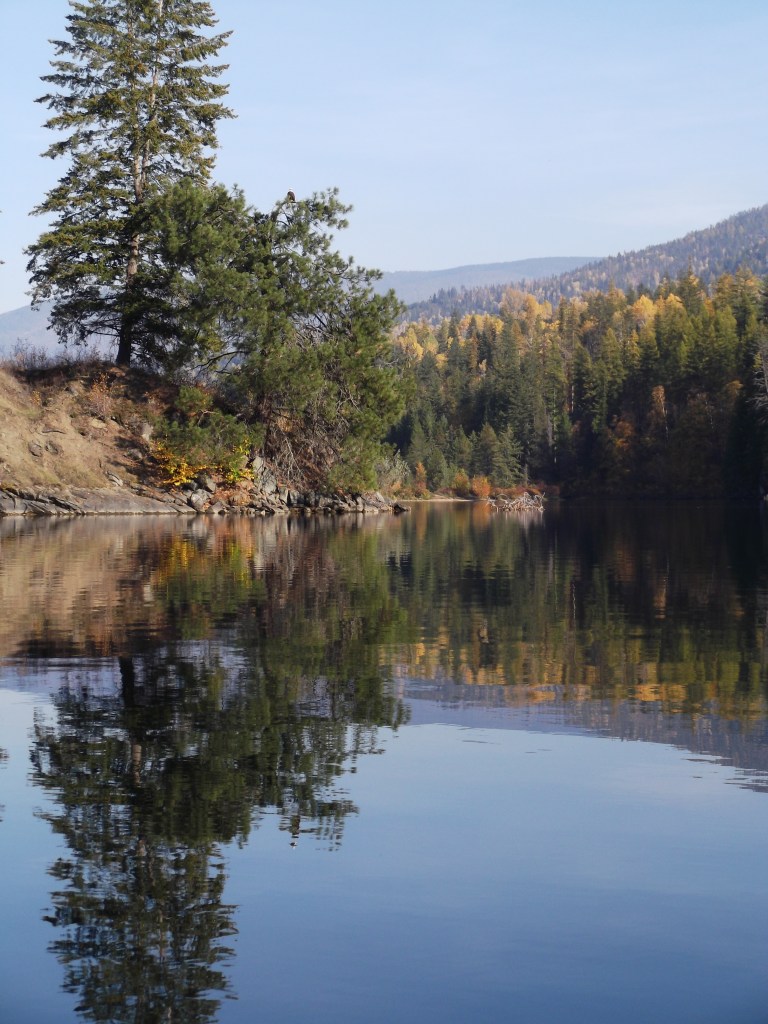


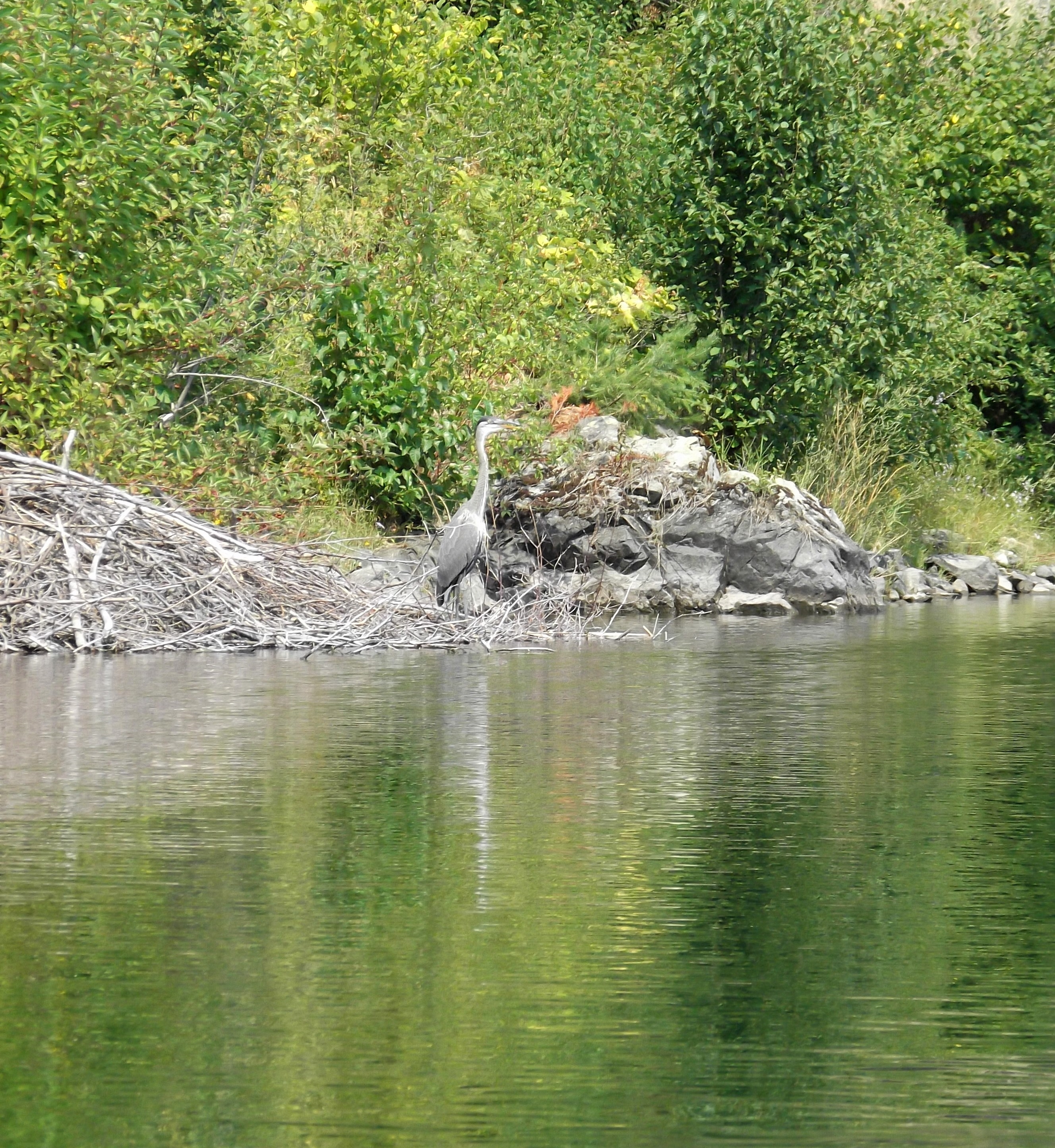

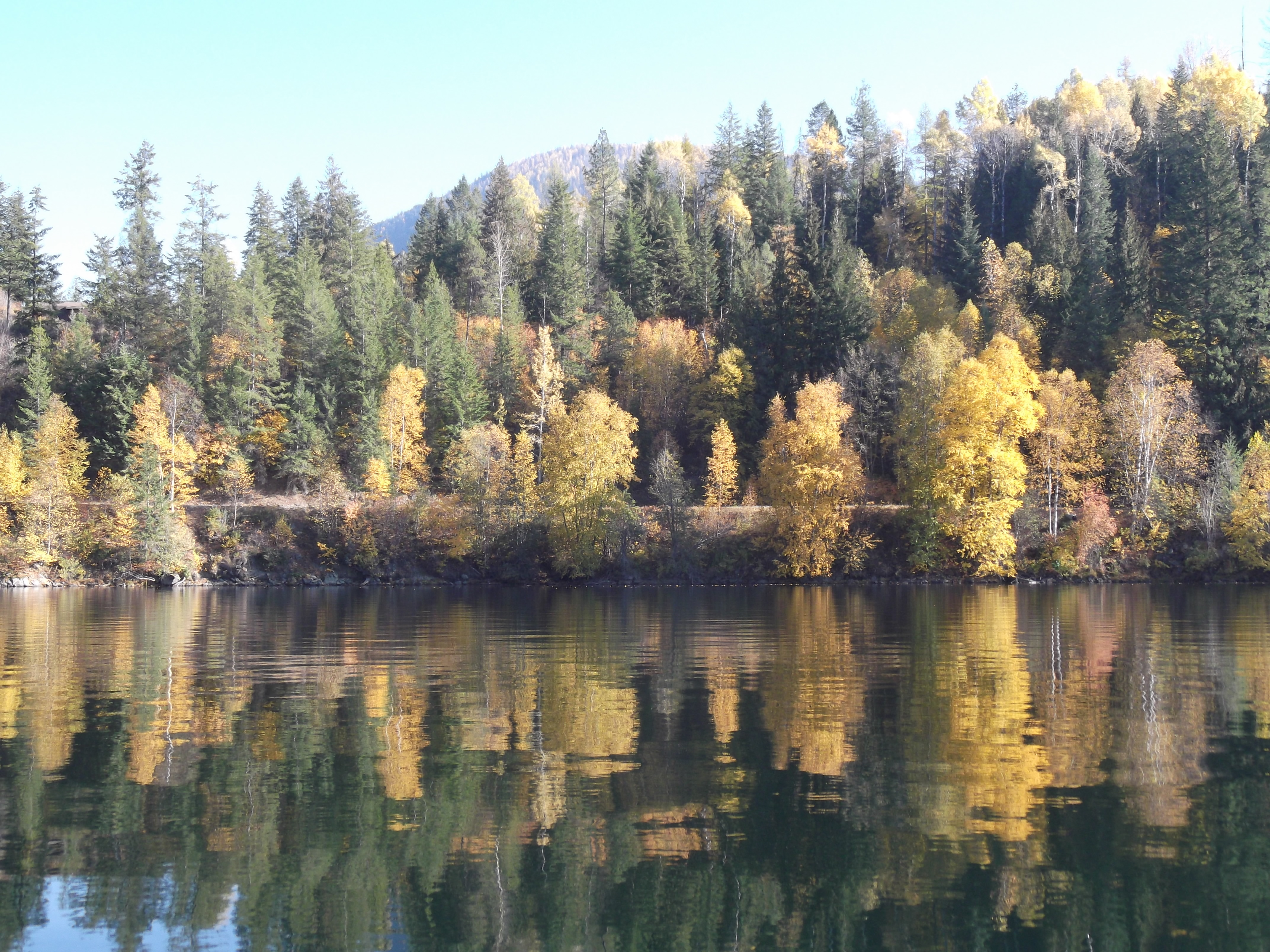

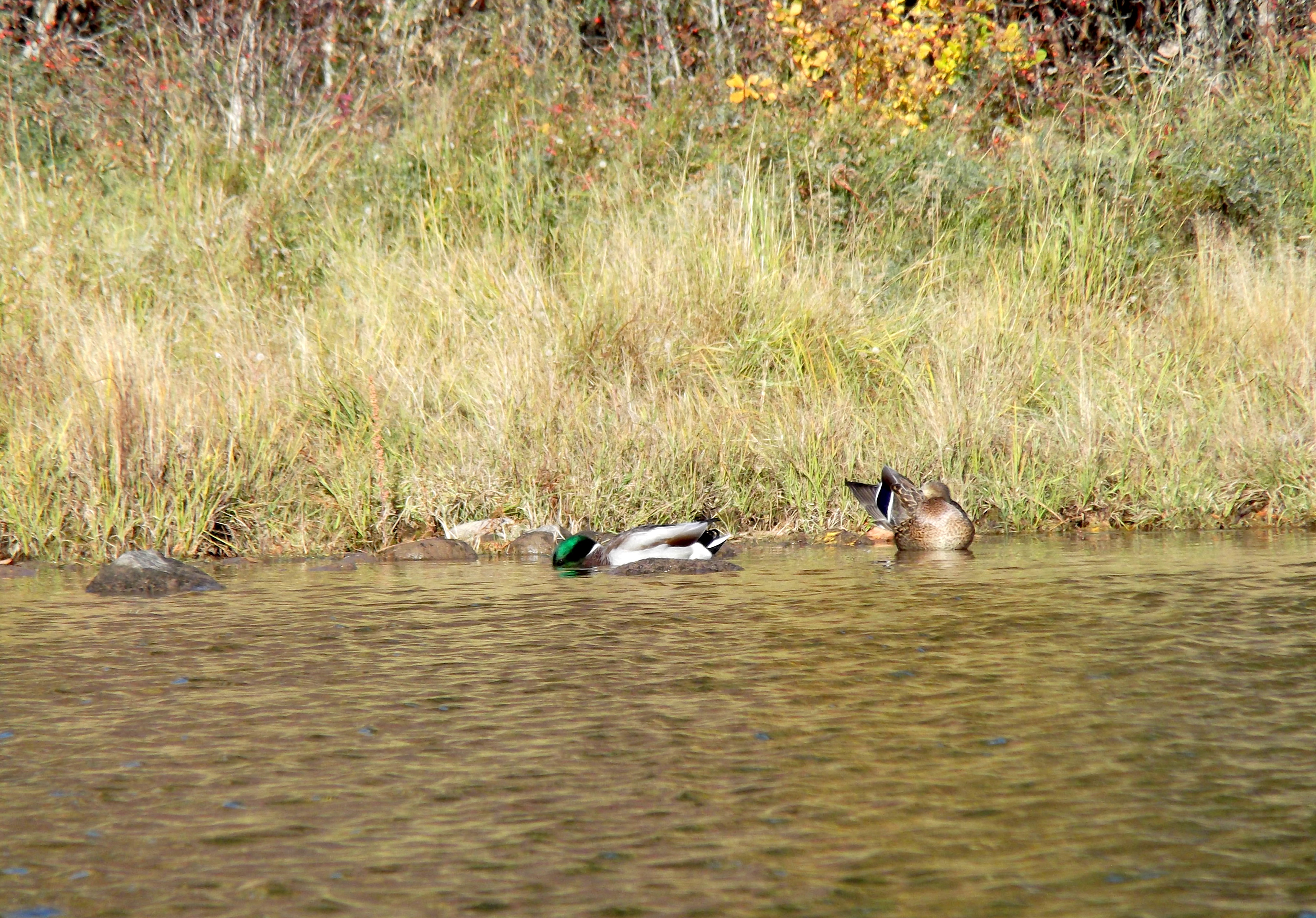


 khabiracandaceblog